How Many Teaspoons Are in a Tablespoon?
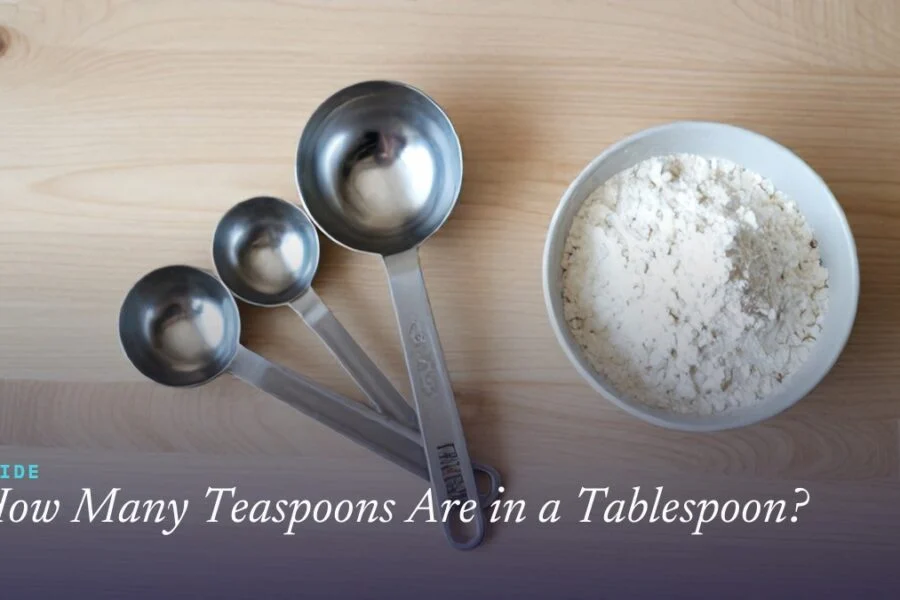
There are 3 teaspoons in 1 tablespoon. That holds whether you’re measuring sugar, salt, vanilla extract, or anything else — it’s a fixed volume ratio, not something that changes with the ingredient.
It’s also one of the few kitchen conversions worth memorizing. It shows up constantly when a recipe uses one unit and your measuring spoons only cover the other.
Quick conversion chart
| Tablespoons | Teaspoons |
|---|---|
| 1/4 tbsp | 0.75 tsp |
| 1/2 tbsp | 1.5 tsp |
| 1 tbsp | 3 tsp |
| 1.5 tbsp | 4.5 tsp |
| 2 tbsp | 6 tsp |
| 3 tbsp | 9 tsp |
| 4 tbsp (1/4 cup) | 12 tsp |
| 5 tbsp + 1 tsp (1/3 cup) | 16 tsp |
| 8 tbsp (1/2 cup) | 24 tsp |
| 16 tbsp (1 cup) | 48 tsp |
To go the other direction, divide by 3. Nine teaspoons equals 3 tablespoons. Fifteen teaspoons equals 5 tablespoons. Twenty-one teaspoons equals 7 tablespoons.
Where the 3:1 ratio comes from
It isn’t an arbitrary kitchen tradition. It’s baked into the US customary system itself. A tablespoon is defined as exactly 3 teaspoons, equal to 1/2 US fluid ounce — the same way a cup is defined as 16 tablespoons.
Learn one of these fixed ratios, and the rest falls into place. 3 tsp equals 1 tbsp. 2 tbsp equals 1 fl oz. 16 tbsp equals 1 cup, and 48 tsp equals that same cup.
The exact metric equivalents
| Unit | US customary | Metric equivalent |
|---|---|---|
| 1 US teaspoon | — | 4.93 mL |
| 1 US tablespoon | 3 tsp | 14.79 mL |
| 1 metric teaspoon | — | 5 mL exactly |
| 1 metric tablespoon | 3 metric tsp | 15 mL exactly |
| 1 US cup | 48 tsp / 16 tbsp | 236.59 mL |
The US and metric spoon sizes are close enough — 4.93 mL versus 5 mL — that most home recipes need no adjustment. The gap is under a milliliter per spoonful.
Baking chemistry is where it can matter. Leavening agents like baking soda and baking powder are dosed precisely. Rounding up from 4.93 to 5 mL across several tablespoons in one recipe can shift a bake’s rise slightly, though it rarely ruins it.
The mistake that actually matters: Australian measuring spoons
This is where recipes go wrong more than people expect. It’s not the country most people guess.
A US tablespoon holds 14.79 mL, or 3 US teaspoons.
A UK, Canadian, or most other Commonwealth metric tablespoon holds 15 mL. That’s also 3 teaspoons, just a rounder metric number, so the ratio still holds.
Australia is the real outlier. An Australian tablespoon holds 20 mL, defined as 4 metric teaspoons rather than 3. Grab an Australian set for a US or UK recipe, and one “tablespoon” delivers a third more volume than the recipe expects.
That’s enough to throw off a baking-powder-heavy recipe. A cake calling for 2 tablespoons of baking powder gets 2.67 US tablespoons’ worth instead. That extra leavening can make it rise too fast, then collapse.
When in doubt on an international recipe, convert everything to teaspoons or milliliters first. Don’t trust “tablespoon” to mean the same volume across sources.
How the ratio holds up when you scale a recipe
The 3:1 ratio is fixed, so it scales cleanly in either direction. The trouble comes from odd fractions, not from the ratio itself.
Halving a recipe: if the original calls for 1 tablespoon (3 tsp), half of that is 1.5 teaspoons. Measure it with a half-teaspoon spoon, or estimate “slightly over 1, slightly under 2.”
Doubling a recipe: 2 tablespoons doubles to 4 tablespoons, or 12 teaspoons. That’s straightforward, since it stays a whole number.
A trickier case: a recipe calling for 2.5 tablespoons of an ingredient converts to 7.5 teaspoons. Without a half-teaspoon measure, that’s 7 level teaspoons plus a scant extra half — close enough for most cooking, but worth measuring carefully for baking.
How to measure without a measuring spoon
- 1 tablespoon is about the size of an ice cube, or roughly half a ping pong ball’s volume.
- 1 teaspoon is about the size of your thumb tip, first knuckle to tip — a rough visual estimate, not accurate enough for baking chemistry.
- In a pinch, a standard soup spoon holds close to 1 tablespoon. A regular flatware teaspoon is close enough for casual cooking, though not for precise baking.
- For dry ingredients like spices or baking soda, level the spoon with the flat edge of a knife instead of leaving a heaping mound. A heaping teaspoon can hold nearly double a level one.
Dry vs. liquid measuring: does it change the ratio
No. The 3:1 ratio is a volume measurement, and volume doesn’t care what’s filling it. Three teaspoons of flour always equal 1 tablespoon of flour by volume.
Three teaspoons of olive oil always equal 1 tablespoon of oil too, even though flour and oil weigh completely different amounts at that same volume. What changes between dry and liquid ingredients is technique, not ratio.
Fill liquid measuring spoons to the brim without spilling. Level dry ingredients off flat instead of packing or heaping them, unless a recipe specifically calls for a “packed” measurement — common with brown sugar.
Frequently asked questions
How many teaspoons are in a cup?
48 teaspoons. A cup holds 16 tablespoons, and each tablespoon holds 3 teaspoons — 16 times 3 equals 48.
Is a tablespoon exactly 3 teaspoons, or is that rounded?
It’s exact in the US customary system. One tablespoon is defined as precisely 3 teaspoons, both derived from the fluid ounce, with no rounding involved.
How many tablespoons are in an ounce?
Two tablespoons make 1 US fluid ounce. So one tablespoon is always exactly half an ounce, and one teaspoon is one-sixth of an ounce.
Does the ratio change for dry ingredients like flour or sugar?
No. The ratio is a volume measurement, not a weight one. Three teaspoons of flour always equal one tablespoon of flour by volume, even though flour and sugar weigh different amounts at that volume.
What about Australian measuring spoons — does the ratio still hold?
The 3-to-1 ratio holds by definition. But an Australian spoon holds 20 mL, not the usual 15 mL. It isn’t directly interchangeable with a US or UK set — measure by teaspoons or milliliters instead of assuming your spoon matches the recipe’s.
What’s the fastest way to remember the ratio without looking it up?
Picture 3 teaspoons lined up — that’s the whole conversion. From there, everything follows: 2 tablespoons is 6 teaspoons, half a tablespoon is 1.5 teaspoons, and a quarter-cup (4 tablespoons) is 12 teaspoons.
Why does US baking measure by volume instead of weight?
US recipe culture grew up around standardized measuring cups and spoons in home kitchens. European and professional baking traditions leaned on kitchen scales instead. Volume measuring is faster for a home cook. It’s also less precise — a cup of flour can vary by 20 grams depending on how it’s scooped.
Related Articles
How Many Teaspoons Are in an Ounce?
Six teaspoons equal 1 fluid ounce. This follows from two conversions you may already know. One fluid ounce equals 2 tablespoons, and one tablespoon equals 3 teaspoons. Multiply…
How Many Tablespoons Are in an Ounce?
Two tablespoons equal 1 fluid ounce. That’s worth double-checking against the ingredient you’re measuring. “Ounce” secretly means two different things in the kitchen, and only one of them…
How Many ML Are in a Teaspoon?
One teaspoon equals 4.93 milliliters. Cooking charts, medicine labels, and most kitchen references round that to 5 mL. Quick conversion chart Teaspoons Milliliters 1/8 tsp 0.62 mL. 1/4…
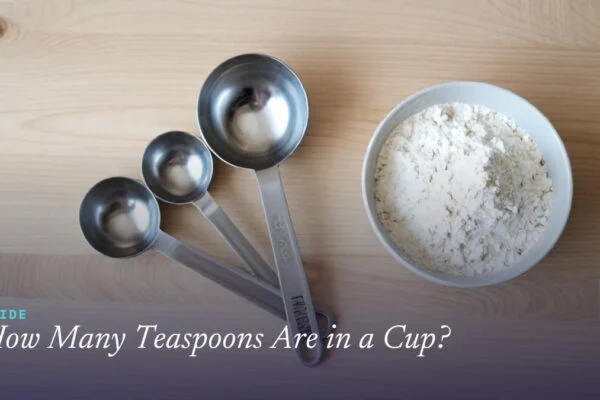
How Many Teaspoons Are in a Cup?
One cup holds 48 teaspoons. That’s a bigger jump than most people expect. The number comes from two smaller conversions stacked together. A cup equals 16 tablespoons, and…