How Many Teaspoons Are in an Ounce?
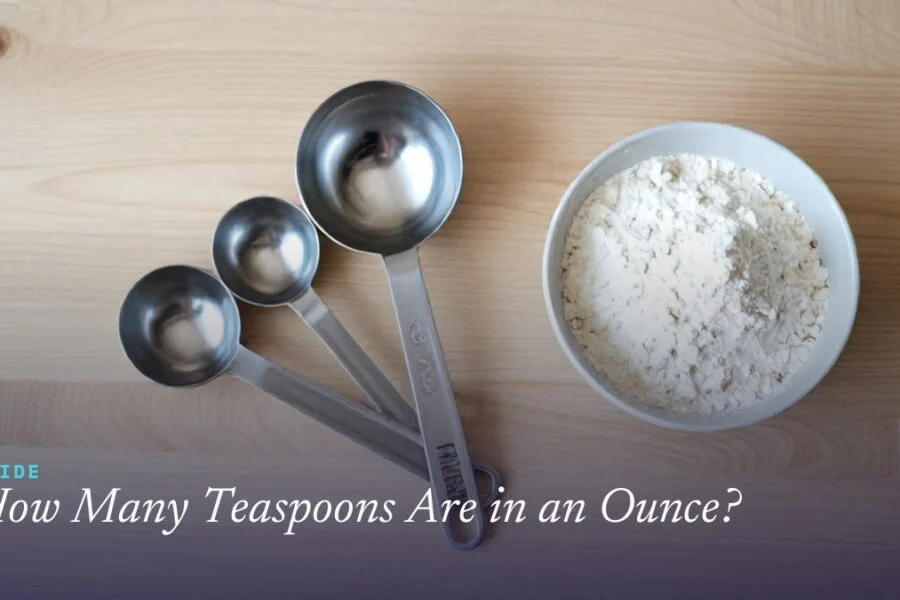
Six teaspoons equal 1 fluid ounce. This follows from two conversions you may already know.
One fluid ounce equals 2 tablespoons, and one tablespoon equals 3 teaspoons. Multiply those: 2 × 3 = 6.
Quick conversion chart
| Fluid ounces | Teaspoons |
|---|---|
| 1/4 fl oz | 1.5 tsp. |
| 1/2 fl oz | 3 tsp. |
| 3/4 fl oz | 4.5 tsp. |
| 1 fl oz | 6 tsp. |
| 1.5 fl oz (a shot) | 9 tsp. |
| 2 fl oz | 12 tsp. |
| 3 fl oz | 18 tsp. |
| 4 fl oz | 24 tsp. |
| 6 fl oz | 36 tsp. |
| 8 fl oz (1 cup) | 48 tsp. |
Same caveat as always: fluid ounces, not weight ounces
This 6-teaspoon ratio only works for liquid measurements. A weight ounce of a dry or dense ingredient — flour, sugar, shredded cheese — doesn’t convert to teaspoons this way.
A teaspoon’s volume holds a different weight depending on what fills it. A teaspoon of granulated sugar weighs about 4.2 grams. A teaspoon of table salt weighs closer to 6 grams, because salt is denser.
Neither one is “1/6 of a weight ounce” in any reliable sense. The 6-teaspoon ratio only holds when you’re measuring a liquid’s volume, not a solid’s weight.
When you’d actually use this
Small liquid doses — flavor extracts, food coloring, liquid supplements — often get measured in fractions of an ounce on packaging. Recipes list the same amount in teaspoons. Converting between the two lets you use whichever tool is actually in your hand.
This comes up with cocktail and cordial recipes too. A bottle is labeled in fluid ounces. A small-batch recipe, though, calls for just a teaspoon or two of a strongly flavored ingredient like bitters.
Worked example: scaling a small-batch recipe
Say a recipe calls for 1/2 fl oz of vanilla extract per batch, and you’re making four batches. First, find the per-batch teaspoon amount.
1/2 fl oz × 6 tsp = 3 tsp.
Multiply by 4 batches: 3 × 4 = 12 teaspoons. That’s a lot of spoon-by-spoon measuring.
Convert back to a practical unit instead: 12 ÷ 6 = 2 fl oz, or 12 ÷ 3 = 4 tablespoons. Use whichever tool is easier to fill accurately.
The metric bridge
One fluid ounce equals 29.57 mL, and one teaspoon equals 4.93 mL. Six teaspoons — 6 × 4.93 = 29.58 mL — comes out to almost exactly 1 fluid ounce. The tiny gap is just decimal rounding.
This helps when reading a dosage or recipe that mixes metric and US measurements. Divide a milliliter amount by 4.93 to get teaspoons, or by 29.57 to get fluid ounces.
How this compares to the tablespoon and cup conversions
Teaspoons, tablespoons, and cups all sit on the same ladder. It helps to see the full chain rather than memorizing each conversion separately.
One teaspoon is 1/6 of a fluid ounce. One tablespoon (3 tsp) is 1/2 of a fluid ounce. One cup (8 fl oz) equals 48 teaspoons.
Once that ladder clicks, pick whichever unit fits the amount. Teaspoons work for anything under half an ounce. Tablespoons cover half an ounce up to a few ounces. Cups take over once you’re well past a single fluid ounce.
Measuring 4 fluid ounces entirely in teaspoons — 24 of them — is technically correct but impractical. Nobody actually counts out two dozen teaspoons when a 1/2 cup measure does the same job in one scoop.
Ounces on labels vs. ounces in a recipe
Packaging almost always lists weight in ounces. “Net wt. 12 fl oz” and “net wt. 12 oz” look nearly identical at a glance, but they mean different things.
A bottle marked “8 fl oz” holds exactly 48 teaspoons of liquid. That “fl” prefix is the label explicitly telling you it’s a volume measurement, not weight.
If a label just says “8 oz” with no “fl,” check the product. Liquids are still usually fluid ounces by convention, even with the abbreviation shortened. Solids and semi-solids — yogurt cups, nut butter jars — are typically weight ounces, and the 6-teaspoon ratio doesn’t apply to those.
Why the ratio is exactly 6, not approximately 6
Some cooking conversions are messy approximations — grams to pounds, for instance, involves an ugly decimal. This one isn’t.
The US customary system defines a tablespoon as exactly 3 teaspoons, and a fluid ounce as exactly 2 tablespoons. The 6-teaspoon figure falls straight out of those definitions, not from any physical measurement or rounding.
That means there’s no “more precise” version of this conversion to look up. Six teaspoons per fluid ounce is exact, full stop — unlike density-dependent weight conversions, which only ever give an approximate answer.
A real example: dosing children’s medicine
Say a liquid allergy medicine label reads “1 fl oz per day, split into two doses.” A parent working out each dose might reach for a kitchen teaspoon.
That’s instead of the dosing cup that shipped with the bottle.
Six teaspoons make up the full ounce, so each half-dose should be 3 teaspoons. But household teaspoons vary by as much as 20% from the true 4.93 mL standard. “3 teaspoons” from a mismatched drawer spoon can undershoot or overshoot the real dose.
The fix is simple. Use the ratio to sanity-check the math, but measure the actual dose with the marked syringe or cup, not a random spoon.
Frequently Asked Questions
How many teaspoons are in half an ounce of vanilla extract?
3 teaspoons. Vanilla extract is a liquid, so the standard 6-teaspoons-per-ounce ratio applies directly.
Is 1 ounce always exactly 6 teaspoons?
For fluid ounces, yes, exactly. It’s a fixed mathematical relationship — 2 tbsp × 3 tsp per tbsp — not an approximation.
How many teaspoons of medicine equal 1 fl oz?
6 teaspoons. For actual medication dosing, use the marked measuring device that comes with the product, not a kitchen teaspoon — kitchen spoons vary in real volume.
How many teaspoons are in a standard shot (1.5 oz)?
9 teaspoons. A shot is a liquid measurement, so the same 6-teaspoons-per-ounce ratio applies, just like any other fluid ounce amount.
How many teaspoons make a tablespoon, and how does that relate to an ounce?
3 teaspoons make 1 tablespoon. 2 tablespoons make 1 fluid ounce. That’s exactly why 1 fluid ounce works out to 6 teaspoons: 3 × 2.
How many ounces are in a teaspoon?
About 0.167 fl oz — one-sixth of an ounce, the inverse of the 6-teaspoons-per-ounce relationship. That’s an awkward fraction, part of why people rarely convert teaspoons to ounces directly.
Related Articles
How Many Tablespoons Are in an Ounce?
Two tablespoons equal 1 fluid ounce. That’s worth double-checking against the ingredient you’re measuring. “Ounce” secretly means two different things in the kitchen, and only one of them…
How Many ML Are in a Teaspoon?
One teaspoon equals 4.93 milliliters. Cooking charts, medicine labels, and most kitchen references round that to 5 mL. Quick conversion chart Teaspoons Milliliters 1/8 tsp 0.62 mL. 1/4…
How Many Teaspoons Are in a Cup?
One cup holds 48 teaspoons. That’s a bigger jump than most people expect. The number comes from two smaller conversions stacked together. A cup equals 16 tablespoons, and…
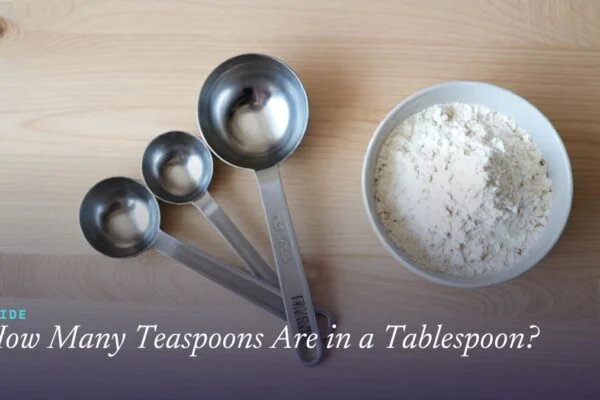
How Many Teaspoons Are in a Tablespoon?
There are 3 teaspoons in 1 tablespoon. That holds whether you’re measuring sugar, salt, vanilla extract, or anything else — it’s a fixed volume ratio, not something that…