How Many Tablespoons Are in an Ounce?
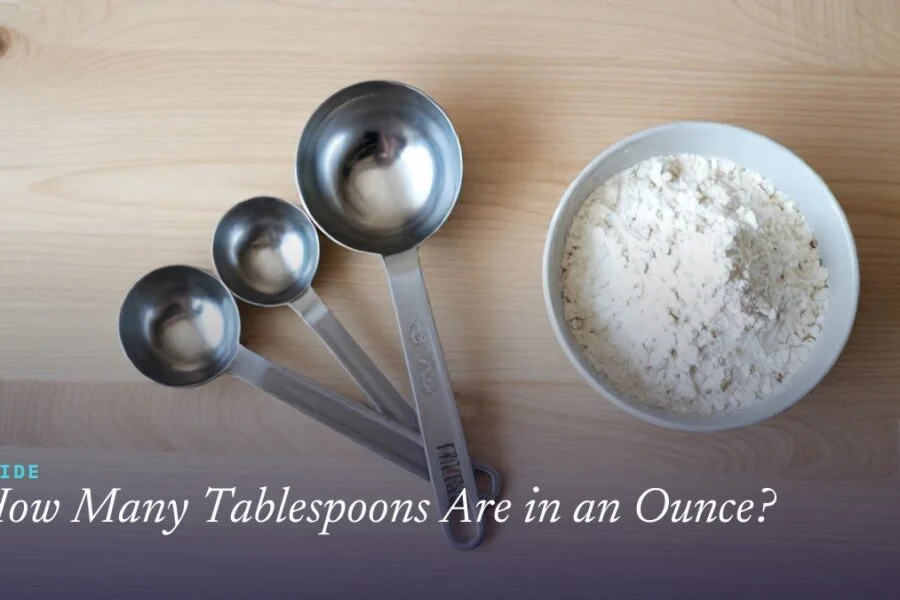
Two tablespoons equal 1 fluid ounce. That’s worth double-checking against the ingredient you’re measuring.
“Ounce” secretly means two different things in the kitchen, and only one of them converts this way.
Quick conversion chart
| Fluid ounces | Tablespoons |
|---|---|
| 1/4 fl oz | 0.5 tbsp. |
| 1/2 fl oz | 1 tbsp. |
| 3/4 fl oz | 1.5 tbsp. |
| 1 fl oz | 2 tbsp. |
| 1.5 fl oz (a shot) | 3 tbsp. |
| 2 fl oz | 4 tbsp. |
| 3 fl oz | 6 tbsp. |
| 4 fl oz | 8 tbsp. |
| 6 fl oz | 12 tbsp. |
| 8 fl oz (1 cup) | 16 tbsp. |
| 16 fl oz (1 pint) | 32 tbsp. |
The mistake that actually causes recipe failures: fluid oz vs. weight oz
A fluid ounce measures volume. This is what converts cleanly to tablespoons — 2 tbsp always equals 1 fl oz.
A weight ounce, as in “4 oz of chocolate chips,” measures mass instead. It doesn’t convert to tablespoons using that same ratio, because different ingredients pack differently into a spoon.
One weight-ounce of flour and one weight-ounce of honey don’t fill the same number of tablespoons. Flour is light and airy; honey is dense and heavy.
If a recipe says “2 oz butter,” that’s almost always weight, not volume. Use a scale, or the volume equivalent printed on the packaging — not the tablespoon ratio above.
When this conversion is reliable
For actual liquids — water, oil, milk, vinegar, liquid extracts — fluid ounces and tablespoons convert predictably. Liquid volume doesn’t change based on what the liquid is.
Two tablespoons of water measures 1 fl oz. Two tablespoons of vegetable oil measures 1 fl oz too.
How weight ounces actually convert, ingredient by ingredient
Density varies, so there’s no single “1 weight oz = X tablespoons” rule. A few common baking ingredients are worth knowing anyway.
- Butter: 1 cup butter = 8 oz = 16 tbsp, so 1 oz of butter equals exactly 2 tbsp. This is one of the few weight-to-tablespoon conversions that lines up conveniently. It’s why butter sticks come pre-marked in tablespoon increments on the wrapper.
- All-purpose flour: a scooped cup weighs roughly 4.2–4.5 oz (120–130g), depending on how it’s packed. So 1 oz of flour is roughly 3.5–3.8 tbsp — not a clean number. That’s one reason precision bakers weigh flour instead of scooping it.
- Granulated sugar: 1 cup weighs about 7 oz, so 1 oz of sugar is roughly 2.3 tbsp.
- Honey: 1 cup weighs about 12 oz, since it’s dense. That makes 1 oz of honey roughly 1.3 tbsp. It’s noticeably less than the 2 tbsp you’d get from a fluid ounce of a thinner liquid.
The metric bridge
One fluid ounce equals 29.57 mL, and one tablespoon equals 14.79 mL. Two tablespoons — 29.57 mL — lines up exactly with 1 fluid ounce, confirming the ratio holds through both systems.
This helps when a recipe lists an ingredient in milliliters and only tablespoon measures are on hand. Divide the mL amount by 14.79 to get tablespoons directly, skipping ounces entirely.
Reading a recipe correctly the first time
Most published recipes are consistent about which “oz” they mean. You just need to know where to look. An ingredient followed by a volume word, or listed beside cups and tablespoons — “1 oz (2 tbsp) vanilla extract” — means fluid ounce.
An ingredient listed with weight context — “8 oz chicken breast,” “4 oz cheddar, shredded” — means weight ounce. No tablespoon conversion applies there without knowing the ingredient’s density.
Packaged goods sold in the US print weight in ounces on the label (“net wt. 12 oz”). That’s a separate use of the word from a recipe calling for “12 oz of milk,” which is a volume measurement.
Reading the surrounding context, not just the number, is what actually prevents mistakes. The abbreviation “oz” alone genuinely doesn’t say which kind is meant.
A quick gut check before you commit to a conversion
Say a calculation implies 1 oz of flour fills 6 tablespoons. If a result like that feels obviously wrong, double-check the ingredient’s density rather than trusting the arithmetic blindly.
Light, airy ingredients — flour, powdered sugar, shredded coconut — pack fewer tablespoons per ounce. Dense ones like honey, peanut butter, and brown sugar pack more.
When precision matters, weighing on a kitchen scale sidesteps the density problem entirely. A scale reads actual weight no matter how loosely or tightly an ingredient sits in the spoon.
A real example: a coconut macaroon batch gone wrong
Say a recipe calls for 4 oz of shredded coconut. A home baker assumes 1 oz always equals 2 tablespoons — the fluid-ounce rule.
Shredded coconut is light and fluffy. In reality, 1 oz of shredded coconut fills closer to 5-6 tablespoons, not 2. Using the fluid-ounce ratio here would leave the batter with less than half the coconut the recipe intended.
That’s the exact failure mode this conversion causes. A “close enough” guess on a weight ingredient, borrowed from a rule that only applies to liquids.
Frequently Asked Questions
How many tablespoons are in 3 fluid ounces?
6 tablespoons. The ratio stays constant at 2 tablespoons per fluid ounce.
Does 1 oz of butter equal 2 tablespoons?
Close. Butter is measured by weight in most recipes, and 1 oz of butter happens to equal about 2 tablespoons by volume. That’s a coincidence of butter’s fairly standard density, not a rule that applies to other ingredients.
How many tablespoons are in a standard shot (1.5 oz)?
3 tablespoons. A shot is a liquid measurement, so the 2-tablespoons-per-ounce ratio applies directly.
Is a jigger the same as an ounce?
A standard jigger measures 1.5 fl oz, not 1 oz. It’s the shot-glass-sized bartending tool, equal to 3 tablespoons. Some jiggers have a second, smaller side marked at 0.75 or 1 fl oz, so check which side you’re using.
How many tablespoons are in 2 oz of a dry ingredient like shredded cheese?
It depends on how the cheese is shredded and packed — this is a weight measurement, not volume. As a rough guide, 2 oz of finely shredded cheese runs close to 4-5 tbsp loosely packed. A kitchen scale is the only way to get this exact.
Why do US recipes list liquids in cups and tablespoons instead of fluid ounces?
Mostly convention. Measuring cups and spoons are the standard kitchen tools in the US, so recipes get written around them. Fluid ounces show up more on packaging and in bartending, where a precise single number matters more than a spoon-sized increment.
Related Articles
How Many Teaspoons Are in an Ounce?
Six teaspoons equal 1 fluid ounce. This follows from two conversions you may already know. One fluid ounce equals 2 tablespoons, and one tablespoon equals 3 teaspoons. Multiply…
How Many ML Are in a Teaspoon?
One teaspoon equals 4.93 milliliters. Cooking charts, medicine labels, and most kitchen references round that to 5 mL. Quick conversion chart Teaspoons Milliliters 1/8 tsp 0.62 mL. 1/4…
How Many Teaspoons Are in a Cup?
One cup holds 48 teaspoons. That’s a bigger jump than most people expect. The number comes from two smaller conversions stacked together. A cup equals 16 tablespoons, and…
How Many Teaspoons Are in a Tablespoon?
There are 3 teaspoons in 1 tablespoon. That holds whether you’re measuring sugar, salt, vanilla extract, or anything else — it’s a fixed volume ratio, not something that…