Length Converter
1 in = 25.4 mm = 2.54 cm = 0.0254 m
Length & DistanceHow to Use This Tool
What the Length Converter Does
The Length Converter turns one length value into its exact equivalent across 8 units at once: inches, feet, yards, and miles on the imperial side, plus millimeters, centimeters, meters, and kilometers on the metric side.
Type a number in any field and every other unit updates instantly. No page reload, no sign-up, no rounded shortcuts.
Imperial vs. Metric, in Short
The US still runs on inches, feet, yards, and miles. Almost everywhere else — and all of international science and engineering — runs on millimeters, centimeters, meters, and kilometers.
Neither system is “more accurate.” They’re just built on different base units. This tool exists for the moment you need a number to work in both.
The 8 Units, at a Glance
- Inch (in) — screens, hardware, shoe and ring sizing
- Foot (ft) — room dimensions, ceiling height, US listings
- Yard (yd) — football, fabric, landscaping
- Mile (mi) — driving distance, races, US road signs
- Millimeter (mm) — engineering tolerances, jewelry, electronics
- Centimeter (cm) — body measurements, small objects, everyday metric use
- Meter (m) — rooms and buildings outside the US, athletics
- Kilometer (km) — driving and running distance outside the US
How the Math Works
Every conversion runs on the exact international standard, not a rounded estimate: 1 inch = 25.4 mm exactly, 1 foot = 0.3048 m exactly, 1 yard = 0.9144 m exactly, 1 mile = 1,609.344 m exactly.
These factors come from the 1959 international yard and pound agreement — the same figures used in engineering and science, not a simplified version. Results stay accurate to six decimal places even on unusual inputs like 137.5 inches.
Length Converter vs. a Single-Pair Tool
Use this all-in-one converter when you want one number shown in every unit at once — good for sizing up an unfamiliar measurement.
Know exactly which two units you need? A dedicated pair converter is faster: Inches to CM, Inches to Feet, Feet to Meters, MM to Inches, or Miles to KM.
Reading a Ruler or Tape Measure
On an imperial ruler, each inch splits into 16ths — the longest unlabeled marks are halves, then quarters, then eighths, then sixteenths.
On a metric ruler, each centimeter splits into 10 millimeters — simpler to read than imperial fractions. Not sure which mark you’re on? Enter the value you’re confident about above and let the converter handle the rest.
Quick Reference Table
| Measurement | Metric equivalent |
|---|---|
| 1 inch | 2.54 cm / 25.4 mm |
| 1 foot | 0.3048 m / 30.48 cm |
| 1 yard | 0.9144 m |
| 1 mile | 1.609 km |
| 6 feet | 1.83 m |
| 100 meters | 328.08 ft |
Frequently Asked Questions
What units does the Length Converter support?
Inches, feet, yards, miles, millimeters, centimeters, meters, and kilometers, the 8 most common length units worldwide.
Are the conversion factors exact?
Yes. All factors follow the 1959 international yard and pound agreement, which sets 1 inch = 25.4 mm exactly. This is the legal standard in the US, UK, Canada, and Australia.
Why does the converter show all units at once?
It makes it easy to compare one value across every common unit, useful when communicating a measurement to someone using a different system.
Can I convert nautical miles?
Not in this tool. Nautical miles (1 NM = 1852 m) are used mainly in aviation and maritime contexts, so they are excluded here.
How do I convert cm to inches without a calculator?
Divide by 2.54, or multiply by roughly 0.3937. Quick estimate: divide by 2.5 and subtract about 2%.
What is the difference between a foot and a yard?
A yard is exactly 3 feet, or 36 inches. Feet are used for rooms and height; yards are more common in fabric, football, and landscaping.
Which countries still use imperial length units?
The US is the only major country where inches, feet, and miles are the everyday standard. The UK and Canada mix imperial and metric; the rest of the world uses metric only.
Formula & Explanation
All length conversions use the international standard factor of 1 inch = 25.4 millimeters exactly, defined in 1959 by the international yard and pound agreement.
Frequently Asked Questions
What units does the Length Converter support?
It supports inches, feet, yards, miles, millimeters, centimeters, meters, and kilometers, the 8 most common length units worldwide.
Are the conversion factors exact?
Yes. All factors follow the 1959 international yard and pound agreement, which sets 1 inch = 25.4 mm exactly. This is the legal standard in the US, UK, Canada, Australia, and most other countries.
Why does the converter show all units at once?
It makes it easy to compare one value across every common unit, useful when you need to communicate a measurement to people using a different system.
Can I convert nautical miles?
Not in this tool. Nautical miles (1 NM = 1852 m) are used mainly in aviation and maritime contexts, so they are excluded here.
How do I convert cm to inches without a calculator?
Divide by 2.54, or multiply by roughly 0.3937. Quick mental estimate: divide by 2.5 and subtract about 2%.
What is the difference between a foot and a yard?
A yard is exactly 3 feet, or 36 inches. Feet are used for rooms and height; yards are more common in fabric, football, and landscaping.
Which countries still use imperial length units?
The US is the only major country where inches, feet, and miles are the everyday standard. The UK and Canada mix imperial and metric; the rest of the world uses metric only.
Related Articles
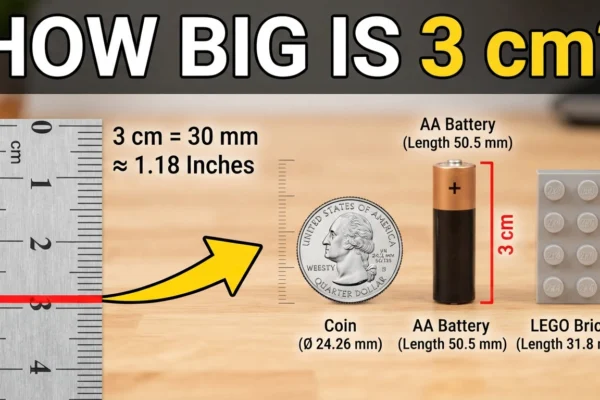
How Big Is 3 cm? Size in Inches, mm, and Real Objects
3 centimeters is 1.18 inches — a hair under 1 3/16 inches on a ruler, and exactly 30 millimeters. To picture it without measuring anything: it’s about the…
10 Everyday Things That Are 24 Inches Long
24 inches equals 2 feet, 60.96 centimeters, 609.6 millimeters, or 0.6096 meters. It is roughly the diagonal size of a small computer monitor, or the height of a…

8 Everyday Things That Are 36 Inches (One Yard)
36 inches equals exactly 3 feet (1 yard), 91.44 centimeters, 914.4 millimeters, or 0.9144 meters. It is the length of a standard yardstick and the standard height of…
9 Everyday Things That Are 60 Inches Tall (5 Feet)
When you think about things that are around 60 inches tall, several common items come to mind. This height is often found in furniture and household items. Here’s…