How Many ML Are in a Teaspoon?
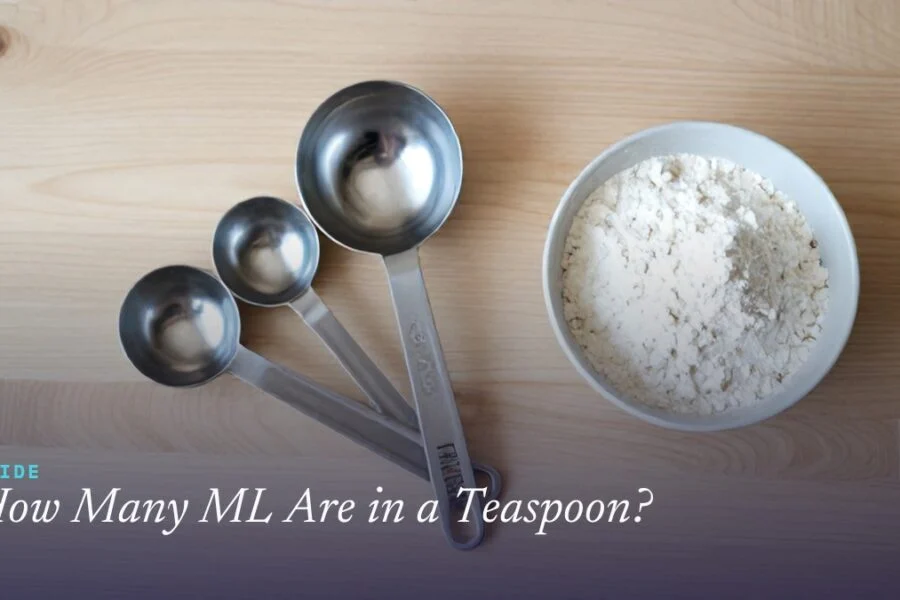
One teaspoon equals 4.93 milliliters. Cooking charts, medicine labels, and most kitchen references round that to 5 mL.
Quick conversion chart
| Teaspoons | Milliliters |
|---|---|
| 1/8 tsp | 0.62 mL. |
| 1/4 tsp | 1.23 mL. |
| 1/2 tsp | 2.46 mL. |
| 3/4 tsp | 3.70 mL. |
| 1 tsp | 4.93 mL (≈5 mL). |
| 1.5 tsp | 7.39 mL. |
| 2 tsp | 9.86 mL (≈10 mL). |
| 3 tsp (1 tbsp) | 14.79 mL (≈15 mL). |
| 4 tsp | 19.72 mL. |
| 5 tsp | 24.64 mL. |
| 6 tsp (2 tbsp) | 29.57 mL (≈1 fl oz). |
Why the “5 mL” rounding exists — and where it matters
The exact figure is 4.92892 mL. Almost everywhere rounds it to 5 mL, because the gap is too small to matter in cooking.
Medicine is different. Liquid doses get measured in mL specifically because a household teaspoon varies depending on which spoon someone grabs. A marked 5 mL dosing cup or oral syringe stays exact every time.
If a medication label says “5 mL,” that’s a precisely calibrated teaspoon-equivalent. Don’t substitute an actual kitchen teaspoon and assume it’s close enough for a child’s dose.
Pharmacies and pediatricians favor mL-marked syringes for exactly this reason. Household spoons vary enough to create real dosing errors, especially where a small overdose matters.
Converting the other direction
Divide milliliters by 4.93 to get teaspoons. Ten mL of liquid medicine works out to just over 2 teaspoons — 2.03 tsp, not a clean 2.
That’s why dosing syringes exist instead of spoon-based estimates. A hundred mL divides out to about 20.3 teaspoons, which helps when reading a medicine bottle’s total volume against a per-dose instruction.
Bridging to tablespoons and cups
A tablespoon holds 3 teaspoons, and a US cup holds 48 teaspoons. The same 4.93 mL figure scales up cleanly across both.
| Unit | Milliliters |
|---|---|
| 1 teaspoon | 4.93 mL. |
| 1 tablespoon (3 tsp) | 14.79 mL. |
| 1/4 cup (4 tbsp) | 59.15 mL. |
| 1/2 cup (8 tbsp) | 118.3 mL. |
| 1 cup (16 tbsp) | 236.6 mL. |
This helps when a recipe mixes measurement systems. Cups and tablespoons might appear on the ingredient list, next to a liquid sold in a metric bottle — 500 mL, 750 mL, 1 L.
Converting everything to milliliters as a common unit avoids stacking small rounding errors across several conversions.
The metric teaspoon vs. the US teaspoon
Some countries define a “teaspoon” as exactly 5 mL, not the US customary 4.93 mL. Australia goes further and uses a 20 mL tablespoon — 4 teaspoons instead of the US 3-teaspoon, 14.79 mL tablespoon.
That’s a genuinely different ratio, not just a rounding difference. If a recipe states “5 mL teaspoon,” or comes from an Australian source, check which convention applies before assuming US measurements carry over.
How many mLs in a teaspoon, in practice
“How many mLs in a teaspoon” and “how many mL in a teaspoon” ask the same thing. The answer is 4.93 mL either way — that extra “s” doesn’t change the figure.
Where this actually gets used day to day is smaller than you’d think. Cough syrup and children’s pain reliever bottles list doses in mL. So do coffee and cocktail recipes borrowed from Europe, and skincare or supplement droppers.
In each case, the task is the same. Translate a volume in one system into a spoon or dropper you actually have on hand.
A note on precision and why it’s fine to round
For cooking, 5 mL sits close enough to 4.93 mL. No home recipe tastes different either way. That 1.4% gap is smaller than the natural variation between two teaspoons pulled from the same drawer.
Precision starts to matter when a small volume gets measured many times and errors compound. A professional kitchen scaling a recipe by a factor of 50, or a lab diluting a solution, can’t absorb that same rounding.
For everyday reference, treating 1 teaspoon as “about 5 mL” works fine. Just don’t apply that shortcut to medicine dosing, where the marked device on the package beats any spoon.
A real mix-up: reading a cough syrup label
Say a cough syrup label reads “10 mL every 6 hours.” The only measuring tool at hand is a kitchen teaspoon.
Someone might assume that’s roughly 2 teaspoons and stop there.
The real figure is 2.03 teaspoons — a small gap, but household teaspoons themselves already run inconsistent by 10-20% depending on the set. Stack both errors together and an actual dose can land noticeably off the intended 10 mL.
This is exactly why the syringe that ships inside the box exists. It measures 10 mL directly, skipping the spoon-to-mL translation entirely.
Frequently Asked Questions
How many mL are in a tablespoon?
About 14.79 mL, rounded to 15 mL. That’s exactly three times a teaspoon, since a tablespoon is defined as 3 teaspoons.
Is a European teaspoon the same size as a US teaspoon?
Close, but not identical. The metric teaspoon is defined as exactly 5 mL, while the US teaspoon is 4.93 mL. The gap is small enough to ignore in cooking, but worth knowing if a recipe states “5 mL teaspoon.”
How many teaspoons is 30 mL?
About 6.1 teaspoons — useful for reading a medicine bottle that lists doses in mL when only a teaspoon is on hand.
How many mL is a dessertspoon?
About 10 mL. A dessertspoon sits between a teaspoon and a tablespoon, roughly double a teaspoon. It shows up mainly in older British recipes and some medicine instructions.
How many teaspoons are in 100 mL?
About 20.3 teaspoons — 100 divided by 4.93. This comes up when estimating how many doses remain in a 100 mL bottle of liquid medicine.
Why do liquid medicine doses use mL instead of teaspoons?
Because “teaspoon” isn’t a precisely standardized volume — actual kitchen teaspoons vary in size. A marked oral syringe or dosing cup measures an exact number of milliliters every time. That matters most for infants and small children, where the margin for error is smaller.
Related Articles
How Many Teaspoons Are in an Ounce?
Six teaspoons equal 1 fluid ounce. This follows from two conversions you may already know. One fluid ounce equals 2 tablespoons, and one tablespoon equals 3 teaspoons. Multiply…
How Many Tablespoons Are in an Ounce?
Two tablespoons equal 1 fluid ounce. That’s worth double-checking against the ingredient you’re measuring. “Ounce” secretly means two different things in the kitchen, and only one of them…
How Many Teaspoons Are in a Cup?
One cup holds 48 teaspoons. That’s a bigger jump than most people expect. The number comes from two smaller conversions stacked together. A cup equals 16 tablespoons, and…
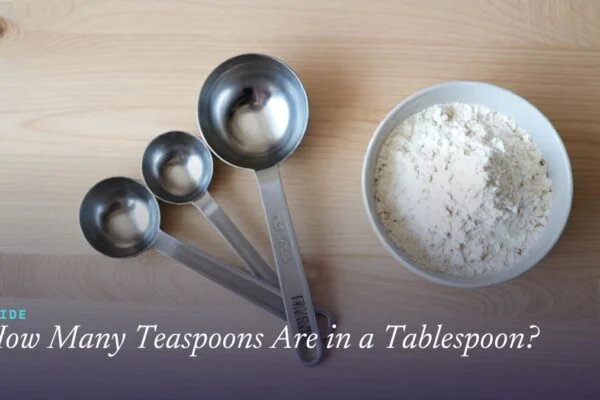
How Many Teaspoons Are in a Tablespoon?
There are 3 teaspoons in 1 tablespoon. That holds whether you’re measuring sugar, salt, vanilla extract, or anything else — it’s a fixed volume ratio, not something that…