How Many Teaspoons Are in a Cup?
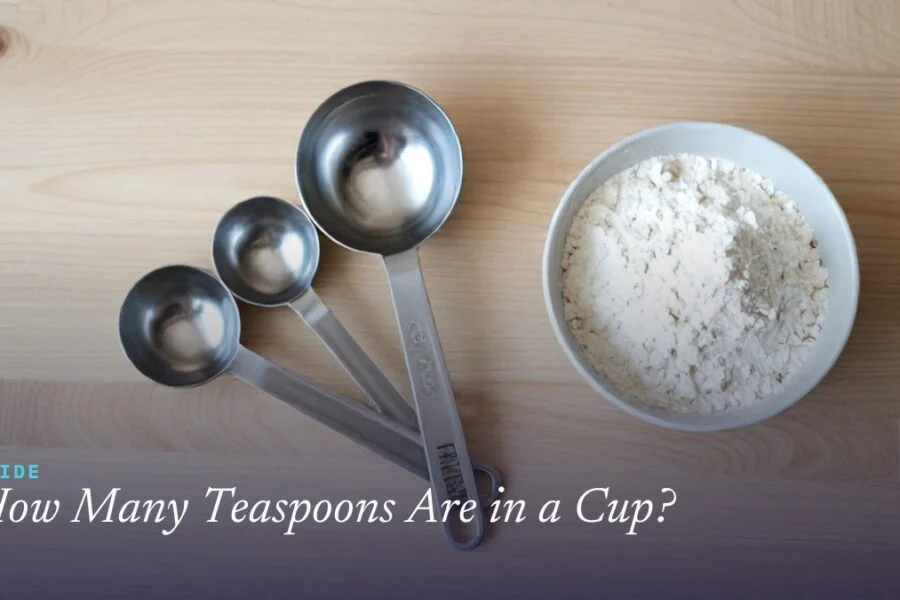
One cup holds 48 teaspoons. That’s a bigger jump than most people expect.
The number comes from two smaller conversions stacked together. A cup equals 16 tablespoons, and each tablespoon equals 3 teaspoons. Multiply those: 16 × 3 = 48.
Quick conversion chart
| Cups | Teaspoons |
|---|---|
| 1/8 cup | 6 tsp |
| 1/6 cup | 8 tsp |
| 1/4 cup | 12 tsp |
| 1/3 cup | 16 tsp |
| 3/8 cup | 18 tsp |
| 1/2 cup | 24 tsp |
| 5/8 cup | 30 tsp |
| 2/3 cup | 32 tsp |
| 3/4 cup | 36 tsp |
| 7/8 cup | 42 tsp |
| 1 cup | 48 tsp |
| 1.5 cups | 72 tsp |
| 2 cups | 96 tsp |
Why this conversion actually comes up
Nobody measures a whole cup out in teaspoons for normal cooking. The math matters when you’re scaling a recipe down.
Say a recipe calls for 1/4 cup of an ingredient, and you’re making a quarter batch. You need 3 teaspoons — one-fourth of 12. Knowing the full teaspoon-per-cup relationship makes that kind of scaling fast.
It also matters when you’re multiplying small amounts. Take 1.5 teaspoons of vanilla, tripled for a big batch: that’s 4.5 teaspoons. Moving fluidly between teaspoons, tablespoons, and cups keeps scaling from turning into guesswork.
Going through tablespoons first is usually easier
For most conversions, convert cups to tablespoons first. One cup equals 16 tablespoons, so this step is simple.
Then drop to teaspoons only for the remainder. Say a recipe needs 5/8 cup. That’s 5/8 × 16 = 10 tablespoons exactly — no teaspoon math required at all.
The teaspoon-only path earns its keep for small quantities: spices, extracts, leavening agents. A tablespoon is too coarse a unit to measure those accurately.
A worked example: scaling a cookie recipe
Say a cookie recipe calls for 3/4 cup of sugar, and you want two and a half batches. First convert 3/4 cup to teaspoons: 3/4 × 48 = 36 tsp.
Multiply by 2.5: 36 × 2.5 = 90 teaspoons. That’s too many to measure spoon by spoon, so convert back to a practical unit.
90 ÷ 48 = 1.875 cups. That’s about 1 cup plus 14 tablespoons, since 0.875 cup equals 14 tablespoons. Teaspoons work as the common denominator that makes an odd multiplier like 2.5 solvable by hand.
Bridging to pints, quarts, and gallons
Because the ratios stack cleanly, teaspoons act as a common unit across the whole US volume ladder.
| Unit | Teaspoons |
|---|---|
| 1 tablespoon | 3 tsp |
| 1 cup | 48 tsp |
| 1 pint (2 cups) | 96 tsp |
| 1 quart (4 cups) | 192 tsp |
| 1 gallon (16 cups) | 768 tsp |
This matters most for batch recipes — brining a turkey, or making a big batch of pickles. A ratio like “salt per quart of brine” needs to scale cleanly to whatever container you’re actually using.
Metric equivalents, for reference
A US teaspoon holds 4.93 mL. A US cup holds 236.59 mL. Multiply 4.93 by 48 and you get 236.6 mL — close enough to confirm the two systems agree once you carry the math through.
This matters if a recipe mixes US cup measurements with a metric ingredient list. Treat “1 cup” and “240 mL” as close enough for most home cooking, though not perfectly identical.
Dry cups vs. liquid cups
The math is identical either way. Forty-eight teaspoons is 48 teaspoons whether you’re measuring flour or milk. But the measuring tool you reach for should match the ingredient.
Dry measuring cups come as a stackable set — 1 cup, 1/2 cup, 1/3 cup, 1/4 cup. Fill one and level it off with a straight edge. That’s how the 48-teaspoon ratio holds up in real use.
Liquid measuring cups are the clear ones with a spout and side markings. Read them at eye level on a flat counter, not tilted in your hand.
Using a liquid cup for flour, or a dry cup for milk, throws off a recipe even when the teaspoon math was perfect. The volume itself gets measured sloppily before the conversion ever matters.
Why some ingredients get measured in teaspoons
Recipe writers reach for teaspoons when a tablespoon would be too coarse. Baking soda, baking powder, salt, spices, and vanilla extract are almost always listed this way.
These ingredients pack a strong effect into a small amount. Double a teaspoon of baking soda by mistake — 2 tsp instead of 1 — and a cake can taste metallic or collapse after over-rising.
That’s why fractional teaspoon amounts deserve real measuring, not an eyeballed guess at “about a third of a tablespoon.”
A common rounding mistake
Someone converting 1/3 cup often rounds it to “about 5 teaspoons” from memory instead of doing the math. The real number is 16 teaspoons.
That’s not a small gap — it’s more than three times the guessed amount. In baking, where 1/3 cup often measures flour or sugar in a ratio-sensitive recipe, a guess that far off can throw off texture completely.
The safer habit: convert through tablespoons first (1/3 cup = 5 tbsp + 1 tsp), then double-check against the 48-teaspoons-per-cup rule if the amount still looks off.
Frequently Asked Questions
How many teaspoons are in half a cup?
24 teaspoons — half of 48.
Is it more accurate to measure a cup by teaspoons or by a measuring cup?
Use a measuring cup. Spooning out 48 individual teaspoons introduces far more room for error than one properly filled cup. This math is for recipe scaling, not a recommended way to measure.
How many tablespoons make 3/4 cup?
12 tablespoons exactly — 3/4 × 16 — with no teaspoon remainder needed.
How many teaspoons are in a third of a cup?
16 teaspoons. 1/3 × 48 = 16, one of the few fractional-cup conversions that lands on a clean whole number.
Why do US and UK teaspoons sometimes give different answers?
A US teaspoon holds 4.93 mL. The UK and metric teaspoon is defined as exactly 5 mL. The gap is too small to matter in most recipes, but it’s worth knowing when converting a British recipe.
How many teaspoons are in a coffee scoop?
A standard coffee scoop holds about 2 tablespoons, or 6 teaspoons. That’s not a cup measurement at all — a common mix-up when a brewing guide references “scoops” instead of standard units.
Related Articles
How Many Teaspoons Are in an Ounce?
Six teaspoons equal 1 fluid ounce. This follows from two conversions you may already know. One fluid ounce equals 2 tablespoons, and one tablespoon equals 3 teaspoons. Multiply…
How Many Tablespoons Are in an Ounce?
Two tablespoons equal 1 fluid ounce. That’s worth double-checking against the ingredient you’re measuring. “Ounce” secretly means two different things in the kitchen, and only one of them…
How Many ML Are in a Teaspoon?
One teaspoon equals 4.93 milliliters. Cooking charts, medicine labels, and most kitchen references round that to 5 mL. Quick conversion chart Teaspoons Milliliters 1/8 tsp 0.62 mL. 1/4…
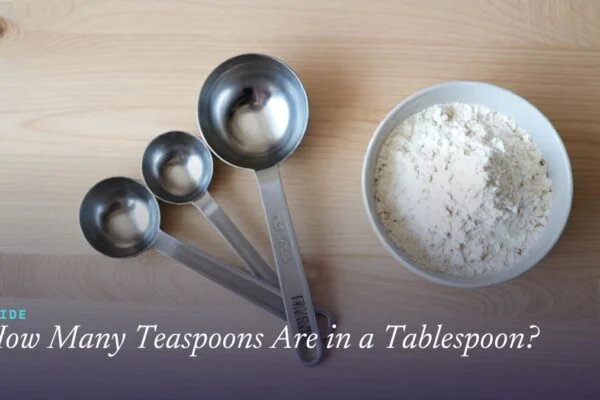
How Many Teaspoons Are in a Tablespoon?
There are 3 teaspoons in 1 tablespoon. That holds whether you’re measuring sugar, salt, vanilla extract, or anything else — it’s a fixed volume ratio, not something that…