What Is Length and Width? A Plain-English Guide
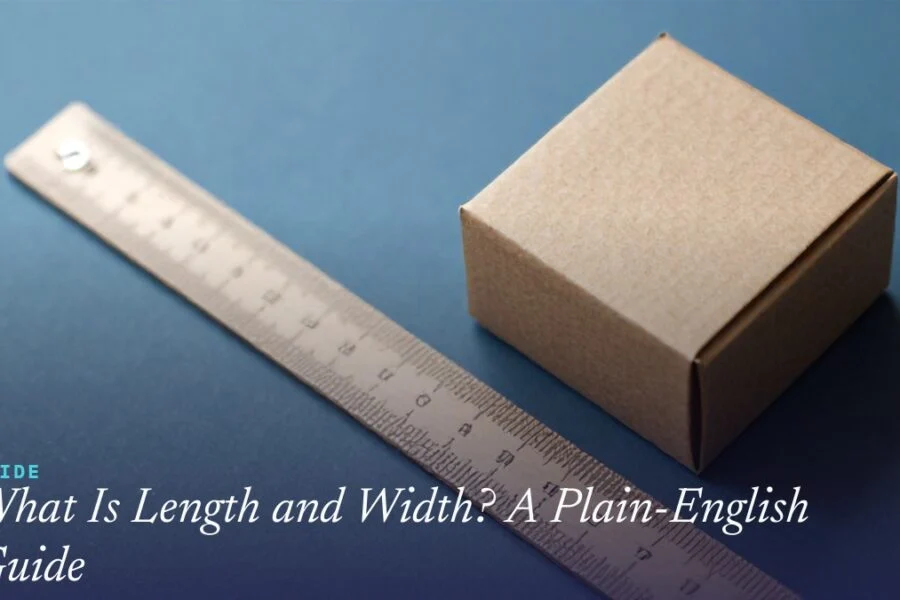
Length is the longer or primary dimension of an object. It’s how far the object extends from one end to the other along its main axis. Width is the shorter, secondary dimension, running side to side, perpendicular to the length.
On a rectangular table, length is the longer edge and width is the shorter one. A rectangular rug follows the same rule: whichever edge runs longer gets called the length.
That definition covers most cases, but not all of them. The exceptions are exactly where people get stuck. A door stands taller than it is wide. Yet nobody calls a door’s height its “length.” A road’s length can run for miles while its width stays a fixed number of lanes.
Below is the full picture. You’ll get the base units behind length and width, how to tell them apart, and how they relate to distance and area.
The basic units of length
| System | Base unit for length | Common subunits |
|---|---|---|
| Metric (SI) | Meter (m) | mm, cm, km |
| US customary | Foot (ft) | inches, yards, miles |
The metric base unit for length is the meter. Every other metric length unit is a power-of-ten multiple or fraction of it. A kilometer is 1,000 meters. A centimeter is 1/100 of a meter, and a millimeter is 1/1,000 of a meter.
That’s what makes the metric base unit for measuring length so convenient. Converting between millimeters, centimeters, and meters just means shifting a decimal point, never doing messy fraction math.
The US customary base unit for measuring length and distance is the foot, though the system doesn’t share metric’s clean decimal structure. Twelve inches make a foot, three feet make a yard, and 5,280 feet make a mile.
Those ratios don’t share a common factor the way metric prefixes do. This foot-based system also covers distance in everyday US use. Road signs, running routes, and property surveys all default to feet and miles instead of meters and kilometers.
What are the basic units of length, smallest to largest
| Unit | System | Roughly equal to |
|---|---|---|
| Millimeter (mm) | Metric | Width of a pencil lead |
| Centimeter (cm) | Metric | Width of a fingernail |
| Inch (in) | US customary | Width of a thumb |
| Foot (ft) | US customary | Length of a standard ruler |
| Yard (yd) | US customary | One long stride |
| Meter (m) | Metric | About 3.3 feet |
| Kilometer (km) | Metric | About 0.62 miles |
| Mile (mi) | US customary | About 1.61 kilometers |
The smallest practical unit of length in everyday metric use is the millimeter. You can technically go smaller — micrometers, nanometers — for scientific work. Nothing below a millimeter shows up on a household tape measure, though.
In US customary units, the smallest common practical unit is the 1/16 inch mark found on standard tape measures and rulers.
How to measure length and width correctly
Identify the object’s orientation. Length runs along the longest or primary axis; width runs perpendicular to it.
Use a rigid tool for anything over a few feet. A tape measure sags on long spans, which introduces error. A laser measure or a straight-edge works more accurately for rooms and furniture.
Measure at the widest and longest points, not an average. Most product listings assume the maximum extent, not a typical cross-section.
Record both numbers with units attached — 54 in x 30 in, not just “54 x 30” — to avoid ambiguity later.
For a rectangle specifically, confirm which side is longer before labeling. Don’t assume the first number given is automatically the length.
How to tell length from width when it’s not obvious
For rectangular objects, the general convention holds: length is the longer side, width is the shorter one. That convention breaks down for objects with a clear “front” or standing orientation.
A door’s “length” in casual conversation usually means its height — how tall it stands. Its width is genuinely the horizontal measurement, regardless of which number happens to be larger.
A bookshelf, a refrigerator, and a television all follow this same logic. Height gets talked about separately from width, and “length” barely enters the conversation at all. Context and the object’s typical use matter more than a strict “longer number = length” rule here.
For a rectangle specifically — the shape people mean when they ask “what is length and width of rectangle” — there’s no ambiguity. Length is simply the longer of the two sides, width the shorter. Multiply the two together to get area.
A rectangle with a length of 12 ft and a width of 5 ft has an area of 60 sq ft. That holds regardless of which side got measured first.
Length vs. distance
Length and distance are closely related but not identical in usage. Length usually describes a fixed, physical dimension that belongs to one object — a rope’s length, a room’s length, a football field’s length.
Distance usually describes the space between two separate points or objects. Think the distance between two cities, or the walk from your car to the front door.
Both get measured in the same units: feet, meters, miles. The unit of distance is the same as the unit of length in every system; there’s no separate “distance unit.” The difference is purely conceptual. Length is a property of one thing. Distance is a relationship between two things.
Width of a rectangle vs. width of everyday objects
The width of a rectangle is a precise geometric term — the shorter of its two perpendicular sides, full stop. The width of a real object gets looser in practice.
A “36-inch-wide” doorway usually means the clear opening a person or furniture piece can pass through. It’s not the outer frame measurement, which often runs an inch or two larger.
When a spec sheet gives a width, check whether it’s the outer dimension or the usable opening. This mistake trips up more furniture and appliance deliveries than any other single measurement error.
Frequently Asked Questions
What is the difference between length and width?
Length is the longer or primary dimension of an object; width is the shorter, perpendicular dimension. On a standard door, height (often loosely called “length” in casual use) runs greater than width — the main exception to the “longer = length” rule.
What is the smallest unit of length?
In the metric system there’s no absolute smallest unit. You can keep dividing into nanometers and picometers for scientific measurements. For everyday use, the millimeter is the smallest practical unit most people encounter.
What is the basic metric unit for measuring length?
The meter. All other metric length units — millimeters, centimeters, kilometers — are decimal multiples or fractions of the meter. That’s what makes metric conversions a matter of moving a decimal point rather than doing fraction math.
How do I find the length and width of a rectangle?
Measure both perpendicular sides directly with a ruler or tape measure. If you only know the area and one dimension, divide the area by the known dimension to find the other. A rectangle with an area of 24 sq ft and a width of 4 ft has a length of 6 ft (24 ÷ 4 = 6).
What are units of length used for besides measuring objects?
The same length units describe distance, height, depth, and perimeter — anything that’s fundamentally a one-dimensional measurement. A “unit of length” isn’t restricted to flat objects. It’s the same meter or foot whether you’re measuring a table, a mountain’s elevation, or the distance around a running track.
Is there a difference between length and height?
Yes, functionally. Length runs along an object’s horizontal or primary axis; height runs vertically. A shipping box has length, width, and height as three distinct measurements — length and width describe the base, height describes how tall it stands. For flat objects lying down, “length” and “height” often aren’t both used; only the relevant one applies.
What is the base unit for measuring distance?
The same as the base unit for length — the meter in metric, the foot (or mile, for longer distances) in US customary. Distance never gets its own separate unit system; it just borrows whichever length unit fits the scale being measured.
Related Articles

How Big Is an Acre? Real-World Size Comparisons in Feet
An acre covers 43,560 square feet. Shaped into a perfect square, that’s about 208.7 feet on each side — a little smaller than a football field. Numbers alone…

How Long Is X Seconds? 14 Real Durations You Can Picture
Seconds are the hardest unit of time to feel intuitively. They’re too short for most people to estimate accurately without counting, and easy to lose track of once…
How Long Is 20+ Feet? Real Object Comparisons
At 20 feet and beyond, you’re out of “hand and body” territory. You’re into “building and vehicle” territory instead. This is the scale where architects, contractors, and sports…
How Tall Is 37+ Inches? Real Object Comparisons
Past three feet, “inches” starts overlapping with height — a TV screen, a doorway, a person. That’s exactly why “how tall is 63 inches in human height” shows…