Cups to Teaspoons Converter
Uncategorized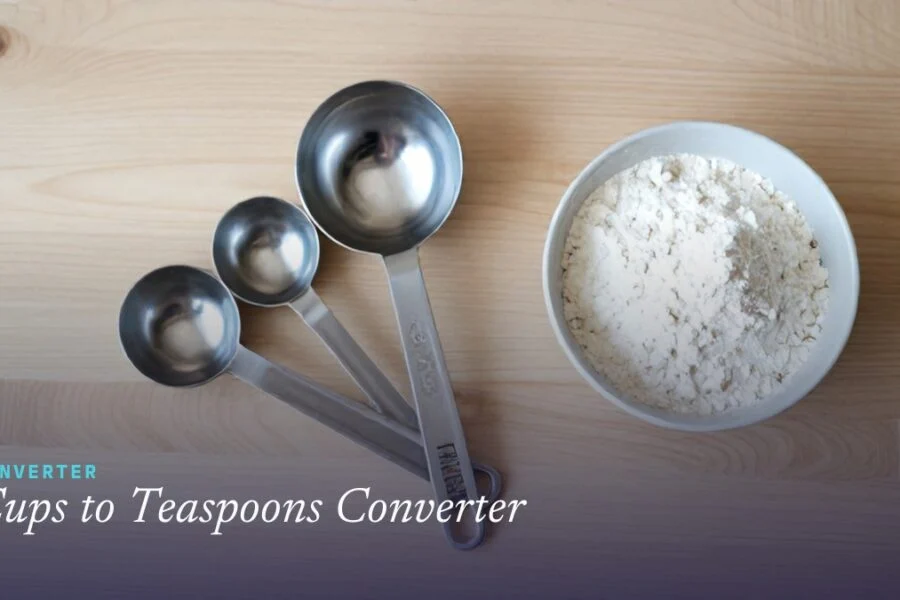
How to Use This Tool
1 cup = 48 teaspoons. To convert cups to teaspoons, multiply by 48. To go the other way, divide teaspoons by 48.
It’s a bigger jump than most kitchen conversions. A teaspoon is such a small unit that 48 of them fit into a single cup.
Formula
teaspoons = cups × 48
cups = teaspoons ÷ 48
Worked example: 8 tsp ÷ 48 = 0.167 cup — a little more than 1/6 of a cup.
Reverse example: 0.5 cup × 48 = 24 tsp.
A cleaner case: 1/4 cup × 48 = 12 tsp exactly. That’s one of the easiest cup-to-teaspoon conversions to keep in your head.
Common cups-to-teaspoons conversions
| Cups | Teaspoons |
|---|---|
| 1/8 cup | 6 tsp |
| 1/6 cup | 8 tsp |
| 1/4 cup | 12 tsp |
| 1/3 cup | 16 tsp |
| 1/2 cup | 24 tsp |
| 2/3 cup | 32 tsp |
| 3/4 cup | 36 tsp |
| 1 cup | 48 tsp |
| 1.5 cups | 72 tsp |
| 2 cups | 96 tsp |
| 3 cups | 144 tsp |
| 4 cups | 192 tsp |
Every value here comes from the same multiplication: cups × 48. The fractional cups look messier because 48 doesn’t divide evenly into every denominator.
1/8 cup gives a clean 6 tsp. A cup measured in thirds — 1/3, 2/3 — also comes out clean, since 48 ÷ 3 = 16 with no remainder.
Why the number is 48
The chain runs through the tablespoon. In US customary measurement, 1 tablespoon equals exactly 3 teaspoons, and 1 cup equals exactly 16 tablespoons.
Multiply those together — 16 tablespoons times 3 teaspoons per tablespoon — and you get 48 teaspoons per cup. It’s not an independently chosen number.
It’s the product of two other fixed kitchen ratios that happen to compound into 48. That’s also why recipes listing both tablespoons and teaspoons for small quantities stay internally consistent.
1 tablespoon, or 3 tsp, is 1/16 of a cup. Stacking 16 of those gets you back to a full cup at 48 teaspoons.
Where 8 teaspoons actually lands
8 teaspoons is a common amount to see called out on its own. It equals 0.167 cup, or roughly 1/6 of a cup.
In kitchen terms, that’s 2 tablespoons and 2 teaspoons, since 8 tsp ÷ 3 = 2 tbsp with 2 tsp left over. If a recipe calls for 8 tsp and your set only has cup and tablespoon markings, use 2 tablespoons plus 2 more level teaspoons.
Don’t try to eyeball a fraction of a cup instead — the gradations aren’t precise enough.
A common mistake with this conversion
The error that trips people up most is skipping the tablespoon step. Trying to eyeball cups directly from teaspoons is hard, because 48 is a large, non-intuitive multiplier.
Someone estimating “24 teaspoons is probably about a third of a cup” gets it wrong. 24 tsp is exactly half a cup — 48 ÷ 2 — not a third.
The safer approach for anything under a full cup: convert through tablespoons first, dividing teaspoons by 3. Then convert tablespoons to cups by dividing by 16.
Both intermediate steps are easier to sanity-check by eye using a standard measuring spoon set. A second common mix-up involves confusing US teaspoons with the UK/metric teaspoon.
A US teaspoon is 4.93 mL. A metric teaspoon is defined as exactly 5 mL.
The difference is small enough to ignore for most home cooking. But it means a US cup, at 48 US tsp, and an “Australian” metric cup don’t convert with the same 48 ratio at all. That system uses a 250 mL cup and 20 mL tablespoons, working out to 50 metric teaspoons per metric cup.
If a recipe’s origin isn’t US customary, check which teaspoon and cup definitions it’s using before applying the 48:1 ratio.
Cups, tablespoons, and teaspoons together
Most kitchen conversions people actually need involve all three units at once, not just cups and teaspoons in isolation. Here’s how they stack.
| Cups | Tablespoons | Teaspoons |
|---|---|---|
| 1/4 cup | 4 tbsp | 12 tsp |
| 1/3 cup | 5.33 tbsp | 16 tsp |
| 1/2 cup | 8 tbsp | 24 tsp |
| 1 cup | 16 tbsp | 48 tsp |
Notice that 1/3 cup is the one awkward row. It comes out to a fractional tablespoon — 5 tbsp plus 1 tsp — even though it converts to a whole number of teaspoons, 16.
That’s because 16 tablespoons per cup doesn’t divide evenly by 3, but 48 teaspoons per cup does. When a recipe needs an odd fraction of a cup measured precisely, teaspoons are usually the cleaner unit to fall back on.
Scaling a recipe up or down
The 48:1 ratio also matters when you’re halving or doubling a recipe. Say a recipe calls for 3/4 cup of an ingredient, which is 36 tsp, and you want a third of the batch.
You need 12 tsp — not an obvious number to land on without doing the cup-to-teaspoon conversion first. Working in teaspoons for small scaled-down quantities avoids rounding errors. Those errors creep in fast when you try to eyeball a fraction of a fraction of a cup.
That’s especially true in a liquid measuring cup, where the gradations usually aren’t fine enough to read accurately below about 1/4 cup.
Frequently Asked Questions
How many cups is 8 teaspoons?
8 teaspoons is 0.167 cup, or about 1/6 of a cup. That’s equivalent to 2 tablespoons plus 2 teaspoons.
How many teaspoons are in a cup?
48 teaspoons. This comes from 16 tablespoons per cup, multiplied by 3 teaspoons per tablespoon.
How many teaspoons are in half a cup?
24 teaspoons — half of the full 48 teaspoons in a cup.
How many teaspoons are in a quarter cup?
12 teaspoons, or 4 tablespoons. 1/4 cup is 4 tablespoons, and each tablespoon holds 3 teaspoons.
Is a US teaspoon the same as a metric teaspoon?
Nearly. A US teaspoon is 4.93 mL and a metric teaspoon is defined as exactly 5 mL — close enough to ignore in most recipes.
The difference does mean US and metric cup systems don’t share the same 48-teaspoon ratio, though.
What’s an easier way to measure 8 teaspoons without a teaspoon spoon?
Use 2 level tablespoons plus 2 teaspoons. Since 1 tablespoon equals 3 teaspoons, 2 tablespoons alone gets you to 6 tsp, and two more teaspoons rounds it out to 8.
How many teaspoons are in 2 cups?
96 teaspoons — double the 48 teaspoons in a single cup.
Related Articles

How Big Is an Acre? Real-World Size Comparisons in Feet
An acre covers 43,560 square feet. Shaped into a perfect square, that’s about 208.7 feet on each side — a little smaller than a football field. Numbers alone…
How Long Is X Seconds? 14 Real Durations You Can Picture
Seconds are the hardest unit of time to feel intuitively. They’re too short for most people to estimate accurately without counting, and easy to lose track of once…
How Long Is 20+ Feet? Real Object Comparisons
At 20 feet and beyond, you’re out of “hand and body” territory. You’re into “building and vehicle” territory instead. This is the scale where architects, contractors, and sports…
How Tall Is 37+ Inches? Real Object Comparisons
Past three feet, “inches” starts overlapping with height — a TV screen, a doorway, a person. That’s exactly why “how tall is 63 inches in human height” shows…