What Weighs a Pound? Everyday Objects That Show You What 1 lb Feels Like
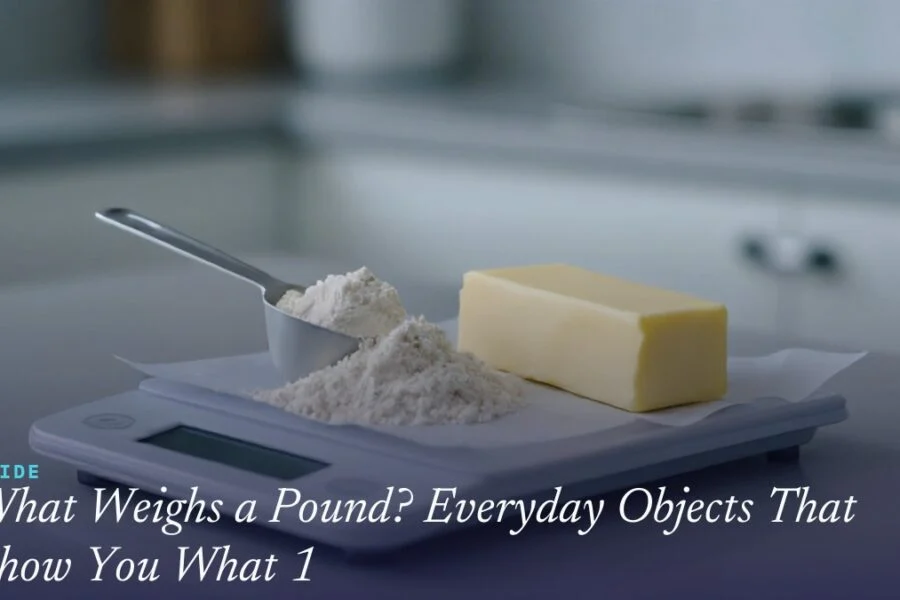
A pound, or 16 ounces, is roughly the weight of a box of pasta, a 16-ounce claw hammer, or a large grapefruit. Picking up any one of those gives you a physical reference point for “1 lb.”
That’s more useful than the number alone. It’s something to compare against when a recipe, a shipping label, or a scale reading says “1 lb.” You get a feel for what that actually means in your hand.
Quick reference: common weights near a pound
| Object | Approximate weight |
|---|---|
| Box of dry pasta | 16 oz (1 lb) |
| Box of butter (4 sticks) | 16 oz (1 lb) |
| Small bag of granulated sugar | 16 oz (1 lb) |
| 16-oz claw hammer | 16 oz (1 lb) |
| Can of black beans or diced tomatoes | 14.5-15.5 oz |
| NFL football | 14-15 oz |
| Large grapefruit | 14-16 oz |
| Average hardcover novel | 16-19 oz |
| Adult eastern gray squirrel | 14 oz-1.3 lb |
Nine everyday objects that weigh about a pound
A box of dry pasta. Nearly every standard box of spaghetti, penne, or rotini on a US grocery shelf sells at 16 ounces. The weight is printed right on the box, which makes it one of the most reliable “exactly 1 lb” objects you own, no scale needed.
A box of butter. A standard box holds four sticks and packages as 1 pound. Manufacturers print that weight on the box too. Since each stick weighs a fixed 4 oz, a single stick works as a rough “quarter pound” reference.
A small bag of granulated sugar. Grocery stores commonly sell sugar in 1-lb bags, alongside larger 4-lb bags. The smaller bag gives you a clean, printed 16-ounce reference if you want one that isn’t a hammer or a tool.
A 16-ounce claw hammer. Hardware gets labeled by head weight, and 16 oz is the most common claw hammer size sold for household use. It’s a genuinely exact pound, not an estimate, because manufacturers build to that spec deliberately.
A can of black beans or diced tomatoes. Standard canned goods run 14.5 to 15.5 ounces net weight, just under a full pound. Most people can’t tell the difference by hand, and nearly everyone has a can like this in the pantry already.
A regulation NFL football. Official rules put a game-ready football at 14 to 15 ounces, just under a pound. That’s about as close as a piece of sports equipment gets to this benchmark.
A large grapefruit. A big grapefruit typically runs 14 to 16 ounces, depending on the specific fruit. It’s one of the few fresh produce items that lands close to a pound on its own, without stacking several together.
An average hardcover novel. A typical trade hardcover, around 300 to 400 pages, generally weighs between 1 and 1.2 pounds. That’s once you count the cover boards and dust jacket. It’s heavier than most people expect until they’ve weighed one.
An adult eastern gray squirrel. Wildlife weight data puts adult gray squirrels at roughly 14 ounces to a bit over a pound. The exact number depends on the season, and on how well-fed the individual animal is. It’s a reasonable living-creature comparison for the “about a pound” range.
What does 10 pounds look like?
Once you have a feel for 1 lb, scaling up to 10 lb gets easier. It becomes a matter of stacking familiar objects, not guessing at a bigger number in the abstract.
- A 10-pound bag of potatoes. Grocery stores commonly sell potatoes in 10-lb bags. It’s a printed, exact match, and one of the easiest ways to physically hold 10 pounds at once.
- A 10-pound bowling ball. Bowling balls get manufactured and labeled by weight in whole pounds, typically from 6 to 16 lb. A 10-lb ball is exactly that, no estimating required.
- A gallon of paint. A full gallon of latex paint weighs approximately 10 to 11 pounds, depending on the formula. That’s close enough to double as a 10-lb reference if you have a can sitting in the garage.
- A gallon of water plus two boxes of pasta. A gallon of water weighs 8.34 lb on its own. Add two of the 1-lb pasta boxes from the list above and you land right around 10.3 lb.
What does 10 pounds of fat look like?
This is really a question about volume, not just weight. Fat tissue is less dense than water — about 0.9 grams per milliliter, compared to water’s 1.0 g/mL.
Ten pounds, or about 4,536 grams, of fat works out to roughly 5 liters in volume. That’s a little over 1.3 gallons.
In physical terms, that lands in the neighborhood of a large watermelon, or a bit more space than a full gallon jug takes up. The reason 10 lb of fat looks bulkier than 10 lb of something denser, like water or metal, comes down entirely to that density difference.
The same weight simply occupies more physical space when the material is less tightly packed. That’s the whole story — nothing about “fat weight” behaves differently from any other substance once you account for density.
Why some “1-pound” objects aren’t exactly 16 ounces
Not everything on this list hits 16.00 ounces precisely. That’s normal, not a measurement error.
Packaged foods like pasta and butter get manufactured to a printed net weight. They’re checked against labeling regulations, so those really do run close to exact. Produce like grapefruit, and living things like squirrels, vary naturally.
A “large” grapefruit isn’t a fixed size the way a hammer head is. No two squirrels weigh precisely the same either.
That’s actually useful for building intuition. A pound isn’t one specific size or shape — it’s a weight that a lot of differently shaped, differently dense objects can share.
A dense, compact object like a hammer head and a lighter, bulkier one like a football can weigh close to the same amount. They just look nothing alike. That’s the same density principle behind why 10 lb of fat looks bigger than 10 lb of a denser material.
Frequently Asked Questions
What is something that weighs exactly a pound?
A standard 16-oz box of dry pasta or a 16-oz claw hammer both get manufactured to that exact weight. The number is printed or stamped right on it. Either makes a reliable reference if you want something precisely 1 lb, not just close.
What household item is closest to 1 lb without being food?
A 16-ounce claw hammer is one of the most exact non-food matches. Hardware tools get built and labeled to a specific weight spec, so there’s no guessing involved.
How much is 10 pounds compared to something I’d recognize?
A 10-lb bag of potatoes or a 10-lb bowling ball are both labeled at that exact weight. That makes them the most direct real-world 10-lb references.
Why does 10 pounds of fat look bigger than 10 pounds of muscle or water?
Because fat is less dense. It runs about 0.9 g/mL, versus roughly 1.06 g/mL for muscle tissue and 1.0 g/mL for water. The same 10-lb weight takes up noticeably more space as fat than as denser tissue or liquid.
Is a pound of feathers really the same weight as a pound of lead?
Yes. Weight doesn’t change with density — only volume does. A pound of feathers and a pound of lead both weigh exactly 16 ounces. The feathers just take up dramatically more space to get there, since they’re far less dense.
What’s a good comparison for half a pound?
Half of any object on the list above works. A half-stick of butter, half a box of pasta, or a standard-size apple all land close to 8 ounces. That makes them handy for eyeballing smaller kitchen measurements.
Related Articles

How Big Is an Acre? Real-World Size Comparisons in Feet
An acre covers 43,560 square feet. Shaped into a perfect square, that’s about 208.7 feet on each side — a little smaller than a football field. Numbers alone…

How Long Is X Seconds? 14 Real Durations You Can Picture
Seconds are the hardest unit of time to feel intuitively. They’re too short for most people to estimate accurately without counting, and easy to lose track of once…
How Long Is 20+ Feet? Real Object Comparisons
At 20 feet and beyond, you’re out of “hand and body” territory. You’re into “building and vehicle” territory instead. This is the scale where architects, contractors, and sports…
How Tall Is 37+ Inches? Real Object Comparisons
Past three feet, “inches” starts overlapping with height — a TV screen, a doorway, a person. That’s exactly why “how tall is 63 inches in human height” shows…