What Are Dimensions? Understanding Measurement Basics
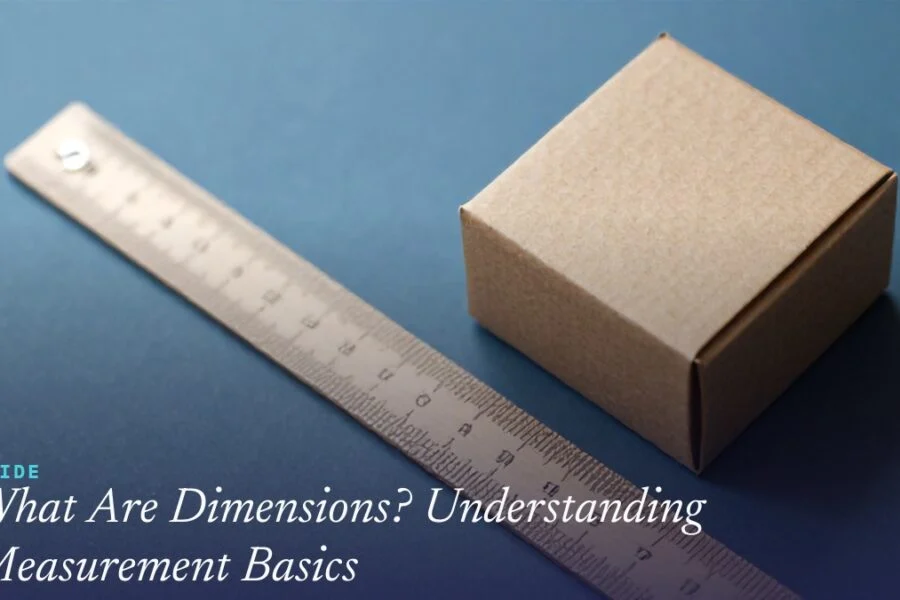
Dimensions are the measurable extents of an object — how far it reaches in each direction that matters for its size. A flat object needs length and width. A solid one needs length, width, and height.
When a product listing, a moving company, or a contractor asks “what are the dimensions,” they want those numbers together. Usually that means a specific order, in a specific unit.
That sounds simple until you’re staring at a furniture listing that just says “32 x 18 x 30” with no labels.
Or you’re trying to figure out whether “the basic unit of measurement” means something different for a box of cereal than a bag of flour. It does. Here’s how dimensions actually work, why the order matters, and where people usually go wrong.
How dimensions are usually written
The standard convention is length × width for a flat object, or length × width × height for a solid one. In practice, plenty of everyday listings quietly swap the order.
Doors, windows, and picture frames commonly get listed as width × height. That’s the order a person actually pictures when imagining the object hanging or standing in place. Shipping boxes, by contrast, follow length × width × height strictly, since that order determines how the box gets palletized and priced.
Example: A box listed as “12 x 8 x 6 inches” typically means 12″ long, 8″ wide, 6″ tall. A door listed as “30 x 80 inches” almost always means 30″ wide, 80″ tall — the opposite convention from the box. No single universal rule covers every product category. That’s exactly why so many “what are the dimensions” questions end up as confused customer-service emails. When precise fit matters — furniture through a doorway, a mattress into a room, an appliance into a cabinet cutout — confirm which number is which. Ask the seller before you order.
Reading a dimension string correctly
| Format seen in listings | Usual meaning | Category where this is common |
|---|---|---|
| L x W x H | Length, width, height | Shipping boxes, storage bins, luggage |
| W x H | Width, height | Doors, windows, TVs, picture frames |
| W x D x H | Width, depth, height | Furniture (dressers, bookshelves, desks) |
| H x W | Height, width | Some appliance spec sheets |
| Diameter x Height | Diameter, then height | Cylindrical objects — pots, candles, tubes |
Here’s a quick tell. A spec sheet with three numbers, on a box-shaped container, almost always means length-width-height.
Two numbers, on something that hangs on a wall or fits into an opening, almost always means width-then-height.
The basic unit of measurement, by category
There’s no single “basic unit of measurement” that covers everything. The question only makes sense once you specify what’s being measured. Each measurable quantity has its own base unit, and mixing them up causes a lot of measurement confusion.
| Quantity | Metric base unit | US customary base unit |
|---|---|---|
| Length | Meter (m) | Foot (ft) |
| Mass / weight | Kilogram (kg) | Pound (lb) |
| Volume | Liter (L) / cubic meter (m³) | Gallon / cubic foot |
| Time | Second (s) | Second (s) |
| Temperature | Celsius / Kelvin | Fahrenheit |
Time is the one category where both systems agree. A second is a second everywhere. Everything else splits along metric vs. US customary lines. That’s why “what is a unit measurement” really has five or six different correct answers, depending on which physical quantity you mean.
The two major measurement systems
Nearly the entire world runs on one of two systems for everyday measurement.
- Metric (International System of Units, SI): used by every country except the United States, Liberia, and Myanmar. It’s built on powers of ten. Converting between units just means moving a decimal point — 1 meter is 100 centimeters, 1 kilogram is 1,000 grams.
- US customary: used primarily in the United States, descended from British imperial units. It’s based on less regular ratios — 12 inches to a foot, 3 feet to a yard, 16 ounces to a pound. None of those share the clean common factor metric prefixes do.
The United Kingdom officially adopted metric for most legal and commercial purposes decades ago. It kept several imperial units in everyday speech anyway: miles for driving distances, pints for beer and milk, stone for body weight.
That partial holdover causes real confusion, because “imperial” and “US customary” aren’t identical either. A US gallon (3.785 liters) is smaller than a UK imperial gallon (4.546 liters). Both trace back to the same historical system anyway.
Converting an old British recipe or spec sheet? Don’t assume “imperial” units match American ones just because both are non-metric.
Why the American measurement system looks the way it does
People sometimes call the US customary system irrational next to metric. It wasn’t designed at random, though.
It grew out of practical, human-scale reference points. A foot was literally about the length of a foot. An acre was roughly what one person could plow in a day. It got standardized later without converting to a base-ten structure.
That’s why US units like the pound, foot, and gallon rely on fixed but non-decimal ratios, instead of metric’s one-base-unit-plus-prefixes approach. It works fine for daily use — nobody needs to convert feet to miles by shifting a decimal point over dinner.
But it makes engineering, science, and international trade calculations more error-prone. That’s a big part of why nearly every scientific field, including in the US, defaults to metric.
Dimensions of common shapes
A rectangle needs exactly two numbers for its dimensions: length and width. Multiply them to get area — a rectangle 8 feet long and 5 feet wide covers 40 square feet.
A rectangular solid, like a box, needs three numbers. Multiply all three for volume — a box 8 x 5 x 3 feet holds 120 cubic feet.
A circle doesn’t really have “length and width” the way a rectangle does. The relevant dimension is the diameter, or the radius, and its area works out to π × radius². Squares are just rectangles where length and width happen to match. A “20 x 20” square only needs one number stated, even though two technically exist.
Frequently Asked Questions
What are the dimensions of a rectangle?
Length and width — the two measurements needed to fully describe a rectangle’s size. Multiply them together for area; a 10 x 4 rectangle covers 40 square units.
What is the measure of a shape called?
It depends on what you’re measuring. The distance around the outside is the perimeter. The space it covers is the area, for flat shapes, or the volume, for solids. “Dimensions” specifically means the individual length/width/height numbers, not the calculated totals.
How do I find the dimensions of an object I can’t measure directly?
Check the product’s official spec sheet, packaging, or manufacturer website. These almost always list dimensions explicitly, often down to a fraction of an inch. If that’s genuinely unavailable, compare the object against a known reference in a photo, or estimate using a nearby object of known size.
What’s the difference between 2D and 3D dimensions?
Two-dimensional objects — a photo, a sheet of paper, a floor plan — have two dimensions, length and width. Their size is expressed as area. Three-dimensional objects — a box, a room, a bottle — add a third dimension, height or depth, and their size is expressed as volume.
What are the units of measure for everyday dimensions?
In the US, dimensions are almost always given in inches or feet for room-sized objects and smaller. Product listings for furniture, electronics, and packaging use inches specifically. Outside the US, centimeters and meters do the same job. Neither is more “correct” — each is just the local convention.
Why do some listings give dimensions in a different order than others?
There’s no single enforced standard across industries. Furniture, shipping, construction, and consumer electronics each settled on their own convention over time, and none of them coordinated with each other. When in doubt, look for explicit labels — L, W, H — rather than assuming order.
Is “dimensions” the same thing as “size”?
Not quite. “Size” is a general term that can mean overall scale, capacity, or even clothing fit. “Dimensions” specifically means the individual measured numbers — length, width, and height — that a listing states side by side. A jacket’s “size” might be Large; its “dimensions” would be actual chest and sleeve measurements in inches.
Related Articles

How Big Is an Acre? Real-World Size Comparisons in Feet
An acre covers 43,560 square feet. Shaped into a perfect square, that’s about 208.7 feet on each side — a little smaller than a football field. Numbers alone…

How Long Is X Seconds? 14 Real Durations You Can Picture
Seconds are the hardest unit of time to feel intuitively. They’re too short for most people to estimate accurately without counting, and easy to lose track of once…
How Long Is 20+ Feet? Real Object Comparisons
At 20 feet and beyond, you’re out of “hand and body” territory. You’re into “building and vehicle” territory instead. This is the scale where architects, contractors, and sports…
How Tall Is 37+ Inches? Real Object Comparisons
Past three feet, “inches” starts overlapping with height — a TV screen, a doorway, a person. That’s exactly why “how tall is 63 inches in human height” shows…