Grams to Pounds Converter
Uncategorized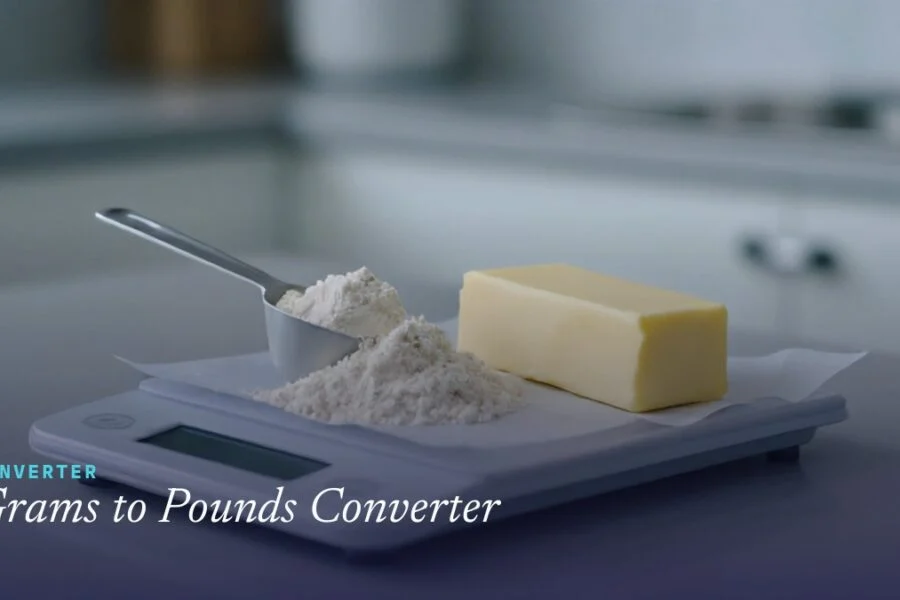
How to Use This Tool
1 pound equals 453.592 grams. Divide grams by 453.592 to get pounds. Multiply pounds by 453.592 to go back.
1 lb in grams is 453.592 g. A 5 lb bag of flour weighs 2,268 g. Going the other way, 1,000 grams (1 kg) comes out to 2.205 pounds.
Formula both directions
- Grams to pounds: lb = g ÷ 453.592
- Pounds to grams: g = lb × 453.592
- Grams to pounds + ounces: whole pounds = g ÷ 453.592, rounded down. Remainder ounces = leftover grams ÷ 453.592 × 16
That last formula matters because a kitchen or postal scale reading in grams often needs reporting as “X lb Y oz,” not a decimal.
Reference table: grams to pounds
| Grams | Pounds (decimal) | Pounds + ounces |
|---|---|---|
| 100 g | 0.220 lb | 0 lb 3.5 oz |
| 250 g | 0.551 lb | 0 lb 8.8 oz |
| 453.592 g | 1 lb | 1 lb 0 oz |
| 500 g | 1.102 lb | 1 lb 1.6 oz |
| 750 g | 1.653 lb | 1 lb 10.5 oz |
| 1,000 g (1 kg) | 2.205 lb | 2 lb 3.3 oz |
| 2,000 g (2 kg) | 4.409 lb | 4 lb 6.6 oz |
| 5,000 g (5 kg) | 11.023 lb | 11 lb 0.4 oz |
Reference table: pounds to grams
| Pounds | Grams |
|---|---|
| 1 lb | 453.592 g |
| 2 lb | 907.18 g |
| 5 lb | 2,267.96 g |
| 10 lb | 4,535.92 g |
| 20 lb | 9,071.85 g |
Why 453.592 is the number
In 1959, an international agreement redefined the pound as exactly 0.45359237 kilograms. That’s where 453.59237 grams comes from.
Before that, several regional pound standards existed — avoirdupois, troy, and tower pounds, each slightly different. The 1959 agreement tied the pound to the metric system instead.
A kilogram holds 1,000 grams, so 1 pound works out to 453.592 grams once rounded to three decimal places. It isn’t a round number because the pound was retrofitted onto the metric system, not designed alongside it.
Worked examples
A 500 g package on a food label: 500 ÷ 453.592 = 1.10 lb. That’s just over a pound. Many “500g” European product sizes get marketed as “1 lb” equivalents in the US, even though the true figure is 1.1 lb.
A newborn weight recorded as 3,400 grams: 3,400 ÷ 453.592 = 7.5 lb, a very typical newborn weight. Hospitals in metric countries often convert this to “7 lb 8 oz” for US relatives.
A 5 lb bag of sugar: 5 × 453.592 = 2,267.96 g, close to 2.27 kg. That figure matters if a recipe or scale only accepts metric input.
The mistake that trips people up: rounding the decimal as ounces
Pounds and ounces don’t split on a base-10 scale, the same way feet and inches don’t. There are 16 ounces to a pound, not 10.
Someone converts 3,400 g and gets 7.497 lb. They read the “.497” as roughly “half an ounce” and round to “7 lb 0.5 oz.” That’s wrong.
0.497 lb × 16 oz/lb = 7.95 oz, not 0.5 oz. So 3,400 g is actually 7 lb 8 oz. The decimal portion has to be multiplied by 16 to get ounces, the same way a feet decimal gets multiplied by 12 to get inches.
A second mix-up confuses grams-to-pounds (mass) with milliliters-to-fluid-ounces (volume). These use completely different conversion factors. They aren’t interchangeable even for water, where density is close to 1:1 but not exact once temperature enters the picture.
Where this conversion actually gets used
Grams-to-pounds shows up in three everyday contexts. Shipping and postage: many carriers weigh packages in grams or kilograms internationally but bill in pounds domestically.
Nutrition labels on imported food: serving sizes printed in grams next to a US label expecting ounces or pounds.
Baby weight: hospitals in metric countries record birth weight in grams. American relatives almost always want that translated into “X pounds Y ounces” instead of a decimal.
It also matters in the kitchen. A recipe from a European or Asian source calling for “500 g of chicken” is really asking for 1.1 lb. That’s close enough to “about a pound” for casual cooking, but not precise enough to skip when baking, where ratios matter more.
Frequently Asked Questions
How many grams is 1 pound?
1 pound equals 453.592 grams, the figure fixed by the 1959 international pound-kilogram agreement.
How many pounds is 1,000 grams?
1,000 ÷ 453.592 = 2.205 pounds, so 1 kilogram is a bit over 2.2 pounds.
Is “1 lb in grams” the same question as “1 lb to grams”?
Yes. Both phrasings ask for the same figure: 453.592 g.
How do I convert grams to pounds and ounces at once?
Divide grams by 453.592 to get decimal pounds. Keep the whole number as pounds. Multiply the leftover decimal by 16 to get the ounce remainder.
Why isn’t 1 pound a round number of grams?
The pound is a customary unit that got pinned to the metric kilogram by international agreement in 1959. It wasn’t designed as a metric fraction from the start.
How many grams is a 2 lb bag?
2 × 453.592 = 907.18 grams, just under 1 kilogram.
How do I convert grams to pounds without a calculator?
Divide by 450 as a rough shortcut, then nudge the answer down slightly. Dividing by the exact 453.592 always gives a smaller figure than dividing by 450.
Is 500 grams the same as 1 pound?
Not quite. 500 g equals 1.1 lb, about 10% more than a pound — close, but not truly interchangeable with a 1 lb package.
Related Articles

How Big Is an Acre? Real-World Size Comparisons in Feet
An acre covers 43,560 square feet. Shaped into a perfect square, that’s about 208.7 feet on each side — a little smaller than a football field. Numbers alone…

How Long Is X Seconds? 14 Real Durations You Can Picture
Seconds are the hardest unit of time to feel intuitively. They’re too short for most people to estimate accurately without counting, and easy to lose track of once…
How Long Is 20+ Feet? Real Object Comparisons
At 20 feet and beyond, you’re out of “hand and body” territory. You’re into “building and vehicle” territory instead. This is the scale where architects, contractors, and sports…
How Tall Is 37+ Inches? Real Object Comparisons
Past three feet, “inches” starts overlapping with height — a TV screen, a doorway, a person. That’s exactly why “how tall is 63 inches in human height” shows…