What Is the Unit of Measure for Volume?
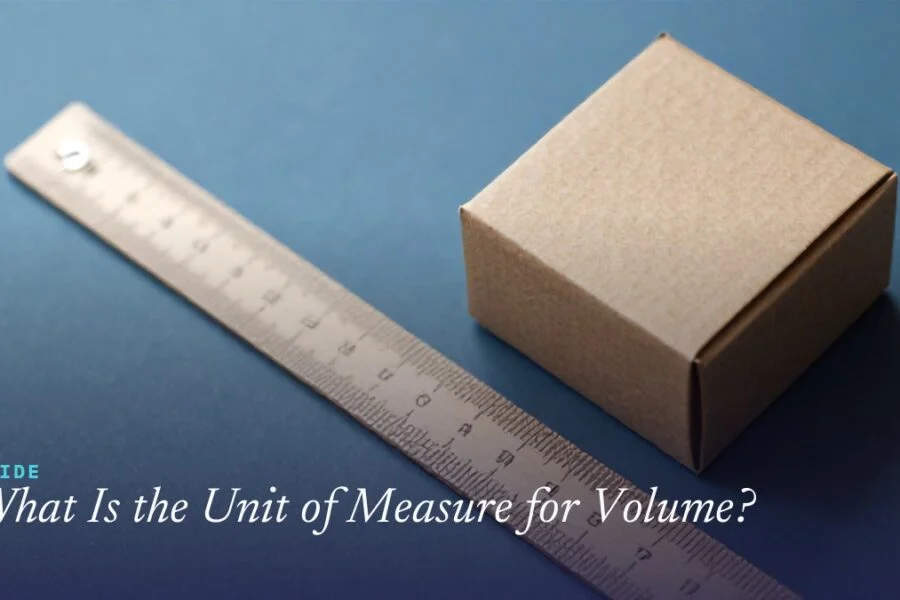
Volume measures how much three-dimensional space something occupies. The metric base unit for volume is the liter for everyday liquid measurements. The cubic meter (m³) is the true SI-derived unit for solids and general space.
The US customary system splits volume by use. Gallons, quarts, pints, and cups handle liquids; cubic feet or cubic inches handle solids and enclosed space.
That split — liquid units vs. solid/space units — is the part that trips people up. “What is the unit of measurement for volume” doesn’t have one universal answer.
Imagine if “what is the unit of measurement for length” used one unit for ropes and a different one for rooms. That’s the same confusion, applied to volume. Here’s how volume units actually break down, how to calculate volume for common shapes, and where the “basic unit of volume” confusion usually starts.
Metric volume units
| Unit | Equal to |
|---|---|
| 1 cubic meter (m³) | 1,000 liters |
| 1 liter (L) | 1,000 milliliters |
| 1 milliliter (mL) | 0.001 liters, 1 cubic centimeter |
| 1 cubic centimeter (cm³) | 1 milliliter, exactly |
The SI base unit for volume is technically the cubic meter. It’s derived directly from the meter — the base unit for length — cubed.
But the liter is the practically-sized unit people actually use day to day. One liter equals exactly 1/1,000 of a cubic meter, or 1,000 cubic centimeters.
So “what is the metric unit for measuring volume” depends on scale. Scientists and engineers working with large spaces use cubic meters. Everyone buying a soda or measuring a recipe uses liters and milliliters instead.
US customary volume units
| Unit | Equal to |
|---|---|
| 1 gallon (gal) | 4 quarts |
| 1 quart (qt) | 2 pints |
| 1 pint (pt) | 2 cups |
| 1 cup (c) | 8 fluid ounces |
| 1 fluid ounce (fl oz) | 2 tablespoons |
| 1 cubic foot (ft³) | 7.48 gallons |
Unlike metric’s clean base-ten scaling, US customary volume units multiply by different factors at every step. Four quarts make a gallon, 2 pints make a quart, 2 cups make a pint, 8 ounces make a cup. None of these share a common base the way liters and milliliters do.
How to find the volume of a box or rectangular solid
volume = length × width × height
Worked example: a box 4 feet long, 3 feet wide, and 2 feet tall holds 4 × 3 × 2 = 24 cubic feet.
Second example, smaller scale: a shipping carton measures 20 inches long, 15 inches wide, and 10 inches tall. That’s 20 × 15 × 10 = 3,000 cubic inches.
Since 1 cubic foot equals 1,728 cubic inches, that’s 3,000 ÷ 1,728 ≈ 1.74 cubic feet. That’s the number a shipping company would actually use for freight pricing.
How to find the volume of other common shapes
- Cube: side³. A cube with 5-inch sides holds 5³ = 125 cubic inches.
- Cylinder: π × radius² × height. A cylinder with a 3-inch radius and 10-inch height holds π × 3² × 10 ≈ 282.7 cubic inches.
- Sphere: (4/3) × π × radius³. A sphere with a 4-inch radius holds (4/3) × π × 4³ ≈ 268.1 cubic inches.
- Cone: (1/3) × π × radius² × height. A cone with a 3-inch radius and 9-inch height holds (1/3) × π × 3² × 9 ≈ 84.8 cubic inches.
- Rectangular pyramid: (1/3) × length × width × height.
For anything irregularly shaped, the practical method is water displacement. Submerge the object in a container of known volume, and measure how much the water level rises. That rise equals the object’s volume.
What is volume measured in, and why liquids and solids differ
Volume gets measured in cubic units for solids and space: cubic inches, cubic feet, cubic meters. Fluids use dedicated liquid units instead — fluid ounces, cups, liters.
Both describe the same underlying concept, three-dimensional space. Liquid units evolved separately because they map to containers people actually use — a cup, a bottle, a jug — rather than abstract cubes.
A gallon and 231 cubic inches describe the same volume. They’re just labeled differently depending on whether you’re pouring milk or calculating how much concrete fills a form.
This is also why “what is volume in liquid” gets asked as its own question. Liquid volume follows the same math as solid volume. Its everyday vocabulary — cups, pints, gallons — just doesn’t obviously connect back to cubic units unless someone points it out.
Volume vs. capacity — is there a difference?
Not really, in everyday use. “Capacity” specifically refers to how much a container can hold — a bottle’s capacity is 1 liter. “Volume” is the broader physical measurement of space occupied.
A solid block of wood has volume but no meaningful “capacity,” since it doesn’t hold anything. In casual conversation, people use the two terms interchangeably for liquids and containers, and no one will misunderstand you either way.
Frequently Asked Questions
What is the SI unit for volume?
The cubic meter (m³) is the official SI-derived unit, calculated as the base length unit cubed. The liter is far more commonly used day to day. A cubic meter is an awkwardly large volume for most households — it’s 1,000 liters.
What are the units of measure for volume in the metric system, smallest to largest?
Milliliter, centiliter (rarely used), liter, then cubic meter. A milliliter is 1/1,000 of a liter; a cubic meter is 1,000 liters. Cubic centimeters and milliliters are identical in size and used interchangeably.
Is volume the same as mass?
No. Volume measures space occupied, while mass measures the amount of matter present. Two objects with the same volume can have very different masses, depending on density. A liter of feathers weighs a fraction of what a liter of lead weighs. Both still occupy exactly one liter of space.
How do I convert cubic feet to gallons?
Multiply cubic feet by 7.48 — 1 cubic foot holds about 7.48 gallons of liquid. A 10-cubic-foot container holds roughly 74.8 gallons.
How do I find the volume of a solid shape that isn’t a box, cylinder, or sphere?
Break irregular shapes into simpler pieces you can calculate separately, then add the results together. When a shape can’t be decomposed this way, use water displacement instead. The volume of liquid displaced when the object is fully submerged equals the object’s volume.
What is the basic unit of volume used in science?
In SI, the formal scientific system, it’s the cubic meter. Laboratory work almost always uses liters and milliliters in practice, though, because cubic meters run too large for typical lab quantities. Chemistry in particular defaults to milliliters and liters for nearly all liquid measurement.
What is the volume of a box measuring 2 feet on each side?
That’s a cube, so use side³: 2 × 2 × 2 = 8 cubic feet. The same formula works whether the “box” is a shipping crate, a fish tank, or a raised garden bed. All three dimensions just need to match.
Related Articles

How Big Is an Acre? Real-World Size Comparisons in Feet
An acre covers 43,560 square feet. Shaped into a perfect square, that’s about 208.7 feet on each side — a little smaller than a football field. Numbers alone…

How Long Is X Seconds? 14 Real Durations You Can Picture
Seconds are the hardest unit of time to feel intuitively. They’re too short for most people to estimate accurately without counting, and easy to lose track of once…
How Long Is 20+ Feet? Real Object Comparisons
At 20 feet and beyond, you’re out of “hand and body” territory. You’re into “building and vehicle” territory instead. This is the scale where architects, contractors, and sports…
How Tall Is 37+ Inches? Real Object Comparisons
Past three feet, “inches” starts overlapping with height — a TV screen, a doorway, a person. That’s exactly why “how tall is 63 inches in human height” shows…