Horse Height in Hands: What Does 15, 17, 18 Hands Mean?
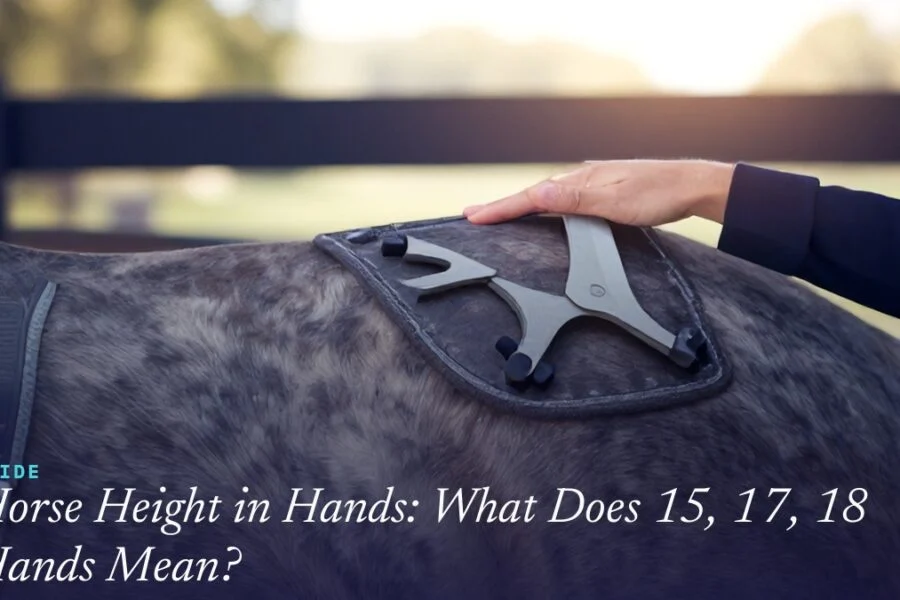
A “hand” is a horse-specific height unit equal to exactly 4 inches. A horse measured at 15 hands stands 60 inches — 5 feet — at the withers.
17 hands works out to 68 inches (5’8″). 18 hands works out to 72 inches (6 feet), genuinely tall for a horse and closer to draft-horse territory than an average riding horse.
Quick conversion chart
| Hands | Inches | Feet-inches | Approx. cm |
|---|---|---|---|
| 10 hh | 40 in | 3’4″ | 101.6 cm |
| 12 hh | 48 in | 4’0″ | 121.9 cm |
| 14 hh | 56 in | 4’8″ | 142.2 cm |
| 14.2 hh | 58 in | 4’10” | 147.3 cm |
| 15 hh | 60 in | 5’0″ | 152.4 cm |
| 16 hh | 64 in | 5’4″ | 162.6 cm |
| 17 hh | 68 in | 5’8″ | 172.7 cm |
| 18 hh | 72 in | 6’0″ | 182.9 cm |
Where the “hand” unit comes from
The hand dates back to ancient Egypt, where it meant the width of an adult male hand across the palm. It survived as a horse-measuring standard because it’s always available — anyone measuring a horse in a field already has one.
English-speaking countries later fixed the unit at exactly 4 inches (10.16 cm) instead of letting it vary hand to hand. That’s why every hands-to-inches conversion today is a clean multiplication by 4, with no averaging involved.
Height in hands gets measured at the withers — the ridge between a horse’s shoulder blades, at the base of the neck. It’s not measured at the top of the head or the ears.
This detail matters most for reading a hands measurement correctly. A horse’s head moves constantly, but the withers stay in a fixed, comparable spot no matter how the horse stands.
Why the decimal point isn’t really a decimal
Owners often write a horse’s height as “15.2 hands.” That notation trips people up if they’re used to normal decimals.
The number after the point isn’t a fraction of a hand. It’s a count of leftover inches, and it only goes up to 3 — 4 inches would just roll into the next whole hand.
So “15.2 hands” means 15 hands plus 2 inches: 60 inches plus 2 inches, or 62 inches total (5’2″). “15.4 hands” doesn’t exist as a valid figure. That gets written as 16 hands instead, the same way 12:60 on a clock becomes 1:00.
Getting this wrong is the single most common horse-height conversion mistake. Read the number after the decimal as inches, never as tenths.
What 15, 17, and 18 hands actually mean
15 hands (60 inches, 5 feet at the withers) sits near the boundary many riding disciplines treat as a solid, average-sized horse. It’s tall enough to be unambiguously a horse rather than a pony. Many Quarter Horses and smaller Thoroughbreds land right around this mark.
17 hands (68 inches, 5’8″ at the withers) counts as a genuinely large horse. Riders use “17 hands” as shorthand for a horse that needs a taller rider to look proportionate, plus a bigger saddle and gear. Many Warmbloods and some size-bred Thoroughbreds fall in this range.
18 hands (72 inches, 6 feet at the withers) is exceptionally tall for a horse. It’s most commonly associated with draft breeds like Shires and Clydesdales, bred historically for pulling power rather than riding speed.
A horse at 18 hands stands taller at the shoulder than most adult humans stand at the top of the head. That comparison usually surprises people encountering the figure for the first time.
The pony vs. horse threshold
The line between a “pony” and a “horse” sits at 14.2 hands — 58 inches, or 4’10” — at the withers on a mature animal. Shorter than that, it’s a pony. Taller, and it’s a horse.
This threshold isn’t just casual terminology. Many breed registries and show organizations use 14.2 hands as the official cutoff for pony-specific classes and eligibility.
A horse and a pony can be separated by half an inch and still land in entirely different competitive categories. Height at the withers stays the practical, universal measuring stick, even though proportions and bone density differ too.
Common mistakes when converting hands to feet or inches
Treating the decimal as a true decimal is the top error, and it’s worth repeating. 16.3 hands means 16 hands plus 3 inches — 67 inches total. It’s not “16 and three-tenths hands.” Multiplying 16.3 by 4 directly gives a wrong answer.
Measuring at the wrong spot on the horse causes the second common error, especially among newcomers. The measurement always happens at the withers, never the top of the head or the ears.
A horse holding its head up can look several inches taller than its actual hands measurement. That’s exactly why withers height became the standardized reference point.
A smaller mistake confuses “hand” with a rough four-inch estimate. The unit is fixed at exactly 4 inches by convention, not an average adult hand width, which varies from person to person. Someone eyeballing a horse’s height with their own hand isn’t using a truly standardized measurement unless they account for that gap.
Frequently Asked Questions
How tall is 15 hands in feet?
15 hands equals 60 inches, or exactly 5 feet, measured at the horse’s withers.
How tall is 17 hands in feet?
17 hands equals 68 inches, or 5 feet 8 inches — a large horse by most riding standards.
How tall is 18 hands in feet?
18 hands equals 72 inches, or exactly 6 feet. That’s an exceptionally tall horse, typically seen in draft breeds like Clydesdales and Shires rather than riding horses.
How many inches is one hand?
One hand equals exactly 4 inches (10.16 cm). It’s a fixed, standardized unit for measuring horse height, not a variable estimate.
What is the difference between a pony and a horse in hands?
The commonly used cutoff is 14.2 hands (58 inches, 4’10”) at the withers on a mature animal. Shorter, and it’s a pony; taller, and it’s a horse. Many breed and show organizations rely on this exact threshold for competitive eligibility.
Where on a horse is height actually measured?
At the withers — the ridge between the shoulder blades at the base of the neck. Not the head or ears, since the withers stay fixed regardless of how the horse holds its head.
What does 15.2 hands mean if the decimal isn’t a normal fraction?
It means 15 hands plus 2 inches, or 62 inches total (5’2″). The number after the point always represents leftover inches, capped at 3, since 4 inches would round up to the next whole hand.
How tall is 16 hands compared to 15 hands?
16 hands is 64 inches (5’4″), four inches taller than 15 hands’ 60 inches. That single-hand jump is roughly the height difference between two adjacent rungs on this chart.
Related Articles
How Big Is an Acre? Real-World Size Comparisons in Feet
An acre covers 43,560 square feet. Shaped into a perfect square, that’s about 208.7 feet on each side — a little smaller than a football field. Numbers alone…

How Long Is X Seconds? 14 Real Durations You Can Picture
Seconds are the hardest unit of time to feel intuitively. They’re too short for most people to estimate accurately without counting, and easy to lose track of once…
How Long Is 20+ Feet? Real Object Comparisons
At 20 feet and beyond, you’re out of “hand and body” territory. You’re into “building and vehicle” territory instead. This is the scale where architects, contractors, and sports…
How Tall Is 37+ Inches? Real Object Comparisons
Past three feet, “inches” starts overlapping with height — a TV screen, a doorway, a person. That’s exactly why “how tall is 63 inches in human height” shows…