MM to Inches Conversion Chart: Fractions, Decimals & Hardware Sizes
The MM to Inches Formula
To convert millimeters to inches, divide by 25.4 (there are exactly 25.4 mm in an inch). To go the other way, multiply inches by 25.4.
Most hardware and tools in the US show fractions instead of decimals, though, which is why the chart below gives you both.
MM to Inches Conversion Chart (1–30mm)
| Millimeters | Decimal Inches | Nearest Fraction |
|---|---|---|
| 1 mm | 0.0394 in | 3/64″ |
| 2 mm | 0.0787 in | 5/64″ |
| 3 mm | 0.1181 in | 1/8″ |
| 4 mm | 0.1575 in | 5/32″ |
| 5 mm | 0.1969 in | 13/64″ |
| 6 mm | 0.2362 in | 15/64″ |
| 7 mm | 0.2756 in | 9/32″ |
| 8 mm | 0.3150 in | 5/16″ |
| 9 mm | 0.3543 in | 23/64″ |
| 10 mm | 0.3937 in | 25/64″ |
| 11 mm | 0.4331 in | 7/16″ |
| 12 mm | 0.4724 in | 15/32″ |
| 13 mm | 0.5118 in | 33/64″ |
| 14 mm | 0.5512 in | 35/64″ |
| 15 mm | 0.5906 in | 19/32″ |
| 16 mm | 0.6299 in | 5/8″ |
| 17 mm | 0.6693 in | 43/64″ |
| 18 mm | 0.7087 in | 45/64″ |
| 19 mm | 0.7480 in | 3/4″ |
| 20 mm | 0.7874 in | 25/32″ |
| 21 mm | 0.8268 in | 53/64″ |
| 22 mm | 0.8661 in | 55/64″ |
| 23 mm | 0.9055 in | 29/32″ |
| 24 mm | 0.9449 in | 15/16″ |
| 25 mm | 0.9843 in | 63/64″ |
| 26 mm | 1.0236 in | 1 1/32″ |
| 27 mm | 1.0630 in | 1 1/16″ |
| 28 mm | 1.1024 in | 1 7/64″ |
| 29 mm | 1.1417 in | 1 9/64″ |
| 30 mm | 1.1811 in | 1 3/16″ |
Need a value above 30mm, or an exact decimal instead of a rounded fraction? The Millimeters to Inches Converter handles any number instantly.
Common Hardware and Socket Sizes
Millimeter-to-inch conversions come up constantly with bolts, drill bits, and wrenches, since US toolboxes mix both systems. A 10mm socket, for example, is close to but not exactly the same as a 3/8″ socket — they’re near-neighbors, not interchangeable, which is a common source of stripped bolts.
If you’re matching a metric part to an imperial tool, always convert first rather than assuming the “closest” size will fit cleanly.
The same conversion comes up outside the toolbox too: watch band widths, jewelry sizing, phone screw sizes, and 3D-printer nozzle diameters are almost always specified in millimeters, even in the US — while the tools people use to work on them are often marked in inches.
Why Fractions Instead of Decimals?
Metric measurements are decimal by design, but US rulers, tape measures, and drill bit sets are still marked in fractions of an inch — typically down to 1/64″. That’s why hardware conversions are usually rounded to the nearest 64th rather than left as a decimal.
It also means small rounding differences are normal. 1mm rounds to 3/64″, but the true decimal value is 0.0394″, not exactly 3/64″ (0.0469″). For most everyday and DIY use, the fraction is close enough; for precision engineering, use the decimal value instead.
Decimal or Fraction: Which Should You Use?
Use decimals for anything that involves a caliper, a CAD drawing, or precision machining — decimals don’t require rounding and stay accurate to as many digits as you need.
Use fractions when you’re working with a physical US tape measure or ruler, since that’s how the markings are actually printed. Just remember that fractions here are rounded to the nearest 1/64″, not perfectly exact.
Frequently Asked Questions
How many inches is 10mm?
10mm equals 0.3937 inches, or approximately 25/64″.
How many inches is 20mm?
20mm equals 0.7874 inches, or approximately 25/32″.
How many mm is 2 inches?
2 inches equals exactly 50.8mm.
How many inches is 8mm?
8mm equals 0.315 inches, or approximately 5/16″.
Is 10mm the same as 3/8 inch?
Not exactly. 10mm is 0.3937″, while 3/8″ is 0.375″ — close, but not interchangeable for a precise fit.
What’s the easiest way to convert mm to inches without a chart?
Divide the millimeter value by 25.4. For a rough estimate, dividing by 25 gets you close enough for most everyday purposes.
Related Reading
Related Articles
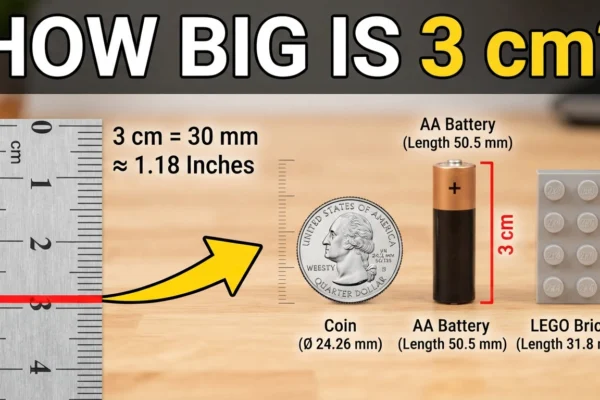
How Big Is 3 cm? Size in Inches, mm, and Real Objects
3 centimeters is 1.18 inches — a hair under 1 3/16 inches on a ruler, and exactly 30 millimeters. To picture it without measuring anything: it’s about the…
10 Everyday Things That Are 24 Inches Long
24 inches equals 2 feet, 60.96 centimeters, 609.6 millimeters, or 0.6096 meters. It is roughly the diagonal size of a small computer monitor, or the height of a…
8 Everyday Things That Are 36 Inches (One Yard)
36 inches equals exactly 3 feet (1 yard), 91.44 centimeters, 914.4 millimeters, or 0.9144 meters. It is the length of a standard yardstick and the standard height of…
9 Everyday Things That Are 60 Inches Tall (5 Feet)
When you think about things that are around 60 inches tall, several common items come to mind. This height is often found in furniture and household items. Here’s…