Height Conversion Chart: Feet, Inches & Centimeters for Every Height

One foot equals 12 inches, and one inch equals 2.54 centimeters exactly. So 5’7″ is 67 inches, which converts to 170.2 cm. Use the chart below to find any height from 4’0″ to 6’11” without doing the math yourself.

Full Height Chart: 4’0″ to 6’11”
This table lists every height in one-inch steps. Find your feet-and-inches figure, then read across for total inches and centimeters.
| Feet & Inches | Total Inches | Centimeters |
|---|---|---|
| 4’0″ | 48 in | 121.9 cm |
| 4’1″ | 49 in | 124.5 cm |
| 4’2″ | 50 in | 127.0 cm |
| 4’3″ | 51 in | 129.5 cm |
| 4’4″ | 52 in | 132.1 cm |
| 4’5″ | 53 in | 134.6 cm |
| 4’6″ | 54 in | 137.2 cm |
| 4’7″ | 55 in | 139.7 cm |
| 4’8″ | 56 in | 142.2 cm |
| 4’9″ | 57 in | 144.8 cm |
| 4’10” | 58 in | 147.3 cm |
| 4’11” | 59 in | 149.9 cm |
| 5’0″ | 60 in | 152.4 cm |
| 5’1″ | 61 in | 154.9 cm |
| 5’2″ | 62 in | 157.5 cm |
| 5’3″ | 63 in | 160.0 cm |
| 5’4″ | 64 in | 162.6 cm |
| 5’5″ | 65 in | 165.1 cm |
| 5’6″ | 66 in | 167.6 cm |
| 5’7″ | 67 in | 170.2 cm |
| 5’8″ | 68 in | 172.7 cm |
| 5’9″ | 69 in | 175.3 cm |
| 5’10” | 70 in | 177.8 cm |
| 5’11” | 71 in | 180.3 cm |
| 6’0″ | 72 in | 182.9 cm |
| 6’1″ | 73 in | 185.4 cm |
| 6’2″ | 74 in | 188.0 cm |
| 6’3″ | 75 in | 190.5 cm |
| 6’4″ | 76 in | 193.0 cm |
| 6’5″ | 77 in | 195.6 cm |
| 6’6″ | 78 in | 198.1 cm |
| 6’7″ | 79 in | 200.7 cm |
| 6’8″ | 80 in | 203.2 cm |
| 6’9″ | 81 in | 205.7 cm |
| 6’10” | 82 in | 208.3 cm |
| 6’11” | 83 in | 210.8 cm |
The Conversion Formula
Converting height takes two steps. Learn them once and you can check any figure by hand.
Step 1: Feet and inches to total inches. Multiply the feet by 12, then add the leftover inches. For 5’9″, that’s (5 × 12) + 9 = 69 inches.
Step 2: Total inches to centimeters. Multiply by 2.54. So 69 inches × 2.54 = 175.26 cm, which rounds to 175.3 cm.
Going backward from centimeters works too. Divide by 2.54 to get inches, then divide by 12 for feet. Take 180 cm: 180 ÷ 2.54 = 70.87 inches. That’s 5 feet (60 inches) with 10.87 inches left over — so 5’11”, rounding to the nearest inch.
Worked Examples
Real numbers make the formula click faster than abstract rules. Here are three heights people search for often.
How tall is 5’2″ in inches? Five feet is 60 inches. Add the 2 inches and you get 62 inches total. In centimeters, that’s 62 × 2.54 = 157.48, rounding to 157.5 cm.
How tall is 5’6″ in centimeters? Convert to inches first: (5 × 12) + 6 = 66 inches. Then 66 × 2.54 = 167.64, which rounds to 167.6 cm.
How tall is 4’11” in inches? Four feet equals 48 inches. Adding 11 more gives 59 inches — the height of a typical countertop is close to 36 inches, so 59 inches is roughly one and two-thirds countertops stacked up.
Common Notation Mistakes
Height notation trips people up more than the math does. Three mix-ups show up constantly.
Mixing up the feet and inch symbols. A single quote (‘) means feet; a double quote (“) means inches. Writing 5″7’ instead of 5’7” is backward, and some databases will misread it as five inches, seven feet.
Forgetting to carry inches over 11. There’s no such height as “5’13”.” Once inches hit 12, they become another foot. Sixty-one inches is written 5’1″, not 4’13”.
Rounding centimeters too early. Someone converting 5’8″ might multiply 68 × 2.5 instead of 2.54, getting 170 cm instead of the correct 172.7 cm — a 2.7 cm gap that adds up across a full chart.
Where the 2.54 Figure Comes From
The inch wasn’t always a fixed number. Different countries used slightly different inch lengths for centuries.
In 1959, the US, UK, Canada, Australia, and other nations agreed on one international standard. That agreement fixed the inch at exactly 2.54 centimeters, no rounding involved.
Every conversion in the chart above uses that exact figure. The centimeter values are precise, not approximations.
Before 1959, a US survey inch and a British inch differed by a few millionths of a centimeter. That gap never mattered for everyday height measurements, but it explains why old US land-survey documents still use a slightly different conversion factor than height charts do today.
Quick Reference for Common Heights
A few heights get searched more than others. Here’s a shortlist pulled straight from the full chart above.
- 5’0″ (60 in) = 152.4 cm — a common baseline height for adult height charts.
- 5’4″ (64 in) = 162.6 cm — close to the global average adult female height.
- 5’9″ (69 in) = 175.3 cm — near the global average adult male height.
- 6’0″ (72 in) = 182.9 cm — the six-foot mark many height requirements reference.
- 6’2″ (74 in) = 188.0 cm — a common threshold on basketball roster listings.
Converting Height to Meters
Meters matter for medical charts, sports databases, and most countries outside the US. The trick is simple: take the centimeter value and move the decimal point two places left.
So 5’9″ (175.3 cm) becomes 1.753 m. There’s no separate formula — meters are just centimeters divided by 100.
How tall is 6’0″ in meters? Six feet is 72 inches. That’s 182.9 cm, which becomes 1.829 m once you shift the decimal.
Most forms that ask for meters want two or three decimal places, not more. Anything past the thousandths place is precision nobody actually measures by hand.
Feet-Inches vs. Metric: Why Both Exist
The US, Liberia, and Myanmar are the only countries that still use feet and inches as the everyday standard. Everywhere else defaults to centimeters and meters.
That split isn’t random. The US inherited imperial units from British colonial measurement and never fully switched during the global shift to the metric system in the 1960s and 1970s.
Height is one of the few measurements where both systems still get used side by side, even within the US. Medical charts often list centimeters, while everyday conversation sticks with feet and inches.
How Precise Should You Round?
Most height charts round centimeters to one decimal place, and that’s plenty for everyday use. Doctors’ offices, ID forms, and clothing sizers all work fine at that precision.
Some contexts want a whole number instead. Round 174.8 cm up to 175 cm; round 174.3 cm down to 174 cm. Standard rounding rules apply — look at the first decimal digit.
Sports and medical records sometimes keep two decimals for exactness. A basketball scouting report might list a player at 198.12 cm rather than 198.1 cm, since fractions of a centimeter can separate similar prospects.
For inches, whole numbers are the norm. Nobody says “5 feet 6.3 inches” in casual conversation — height gets rounded to the nearest whole inch almost everywhere outside a lab.
Checking Your Own Conversion
You don’t need a chart to double-check a number — just the two-step formula and a calculator. It takes about ten seconds.
Try it with 5’11”. Multiply 5 by 12, then add 11: that’s 71 inches. Multiply 71 by 2.54, and you get 180.34, which rounds to 180.3 cm.
Now compare that against the chart above. Row 5’11” lists 71 in and 180.3 cm — an exact match, which confirms the formula works the same way every time.
That’s the real value of learning the math: you can verify any height, not just the ones already listed in a table.
Frequently Asked Questions
How do I convert feet and inches to centimeters?
Multiply the feet by 12, add the extra inches, then multiply that total by 2.54. For 5’5″, that’s 65 inches × 2.54 = 165.1 cm.
How tall is 5’7″ in inches?
Five feet is 60 inches. Add 7 more and you get 67 inches total, which equals 170.2 cm.
How tall is 5’10” in inches?
Five feet equals 60 inches, plus 10 more gives 70 inches. That converts to 177.8 cm.
Is a height chart in inches the same as one in centimeters?
No — they show the same heights, just in different units. Our chart above lists both side by side so you never need a separate calculator.
Why do UK and US height charts look different?
Both use the same inch and centimeter values today. The difference is presentation: many UK sources lead with centimeters, while US sources usually lead with feet and inches.
What’s the fastest way to estimate height in centimeters without a chart?
Multiply your total inches by 2.5 for a rough figure. Add roughly 1 cm for every 40 inches of height to correct for the missing 0.04. It won’t be exact, but it lands within half a centimeter for most adult heights.
How tall is 5’3″ in centimeters?
Five feet is 60 inches, plus 3 more equals 63 inches. Multiply by 2.54 and you get exactly 160.0 cm.
Do height charts round up or down?
Standard rounding applies both ways, based on the digit after the decimal point. A value of 165.15 cm rounds up to 165.2 cm; 165.14 cm rounds down to 165.1 cm.
Related Articles
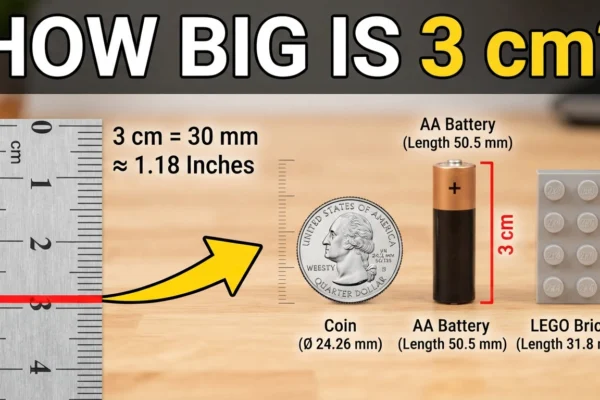
How Big Is 3 cm? Size in Inches, mm, and Real Objects
3 centimeters is 1.18 inches — a hair under 1 3/16 inches on a ruler, and exactly 30 millimeters. To picture it without measuring anything: it’s about the…
10 Everyday Things That Are 24 Inches Long
24 inches equals 2 feet, 60.96 centimeters, 609.6 millimeters, or 0.6096 meters. It is roughly the diagonal size of a small computer monitor, or the height of a…
8 Everyday Things That Are 36 Inches (One Yard)
36 inches equals exactly 3 feet (1 yard), 91.44 centimeters, 914.4 millimeters, or 0.9144 meters. It is the length of a standard yardstick and the standard height of…
9 Everyday Things That Are 60 Inches Tall (5 Feet)
When you think about things that are around 60 inches tall, several common items come to mind. This height is often found in furniture and household items. Here’s…