How Many Grams Are in a Pound?
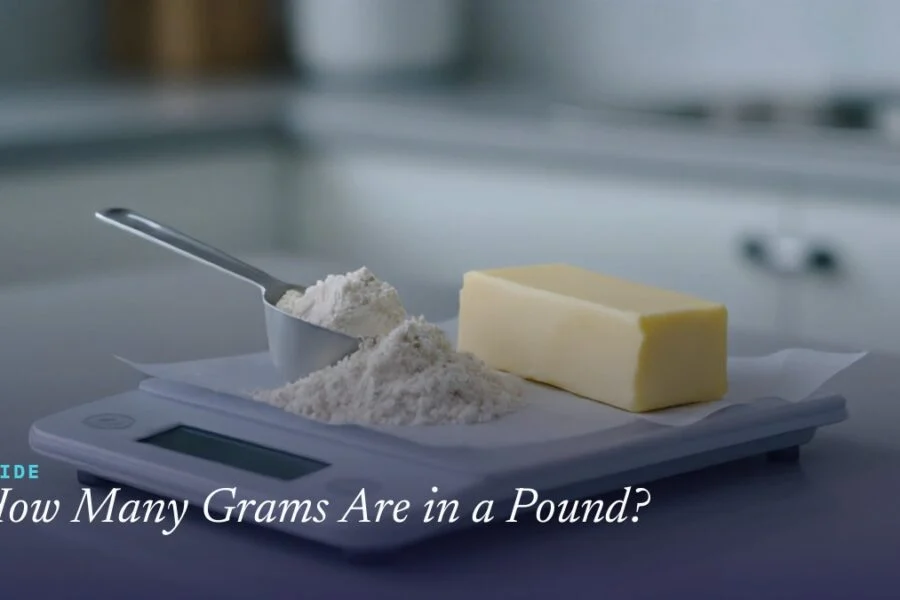
One pound equals 453.592 grams. Most people round that to 454 grams for everyday use.
The extra precision rarely matters outside a lab or a jeweler’s scale.
Quick conversion chart
| Pounds | Grams |
|---|---|
| 1/4 lb | 113.4 g |
| 1/2 lb | 226.8 g |
| 3/4 lb | 340.2 g |
| 1 lb | 453.6 g |
| 1.5 lb | 680.4 g |
| 2 lb | 907.2 g |
| 3 lb | 1,360.8 g |
| 5 lb | 2,268 g |
| 10 lb | 4,536 g |
| 25 lb | 11,340 g |
| 50 lb | 22,680 g |
| 100 lb | 45,360 g |
To reverse the math, divide grams by 453.592. One kilogram — 1,000 grams — comes out to about 2.2 pounds.
Where 453.592 comes from
The pound wasn’t originally built as a metric-friendly round number. It was standardized against the kilogram in 1959.
That year, the US, UK, Canada, Australia, and South Africa agreed the international avoirdupois pound would equal exactly 0.45359237 kilograms. Every unit downstream — grams, ounces, stone — inherits that awkward decimal.
The mistake people actually make
Grams and ounces get confused constantly. A pound holds 16 ounces and roughly 454 grams — two separate facts that don’t relate to each other directly.
Seeing “16” and “454” side by side on a food label makes them look proportional. They aren’t. They’re just two different ways of dividing up the same pound.
If a recipe calls for “8 oz” and you’re working in grams, that’s half a pound: about 227g. It’s not “8 grams,” and it’s not some rough guess.
Converting grams to pounds: a worked example
Say a package label lists 2,500 grams, and you need the weight in pounds. Divide by 453.592: 2,500 ÷ 453.592 = 5.51 lb.
For a fast mental estimate, divide by 450 instead. 2,500 ÷ 450 ≈ 5.56 — close enough for casual use.
The exact figure matters when precision counts. Shipping costs calculated per pound, or a candy recipe where a few grams changes the outcome, both demand the real number, not the shortcut.
The ounce bridge
A pound is both 16 ounces and 453.592 grams. Divide one by the other and you get the weight of a single ounce: 453.592 ÷ 16 = 28.35 g.
That figure is worth memorizing on its own. Food labels, postage scales, and nutrition panels often list weight in ounces or grams without mentioning pounds at all.
Being able to bridge between all three units without a calculator saves constant back-and-forth.
Not every “pound” is the same pound
The 453.592g figure describes the avoirdupois pound — the everyday pound used for body weight, groceries, and shipping in the US and UK.
A separate troy pound exists for precious metals like gold and silver. It equals about 373.24 grams, noticeably lighter than the pound most people know.
Gold gets weighed in troy ounces (31.1g each), not the avoirdupois ounces (28.35g each) used for groceries. That’s the trick behind the old riddle about a pound of feathers versus a pound of gold — by the numbers jewelers actually use, a troy pound of gold weighs less than an avoirdupois pound of feathers.
For everyday grams-to-pounds conversion, avoirdupois is the default. A jeweler or coin dealer will say so if they mean troy weight instead.
Using a kitchen scale to check your math
Most digital kitchen scales toggle between grams and pounds with one button. That makes them the easiest way to sanity-check a manual conversion.
Weigh out what you calculate as 1.5 lb of flour. If the scale reads far from 680g, the math was probably off — a quick way to catch an arithmetic mistake before it ruins a recipe.
Scales that display only one unit system are worth avoiding if you cook from both US and international recipes. Manual conversion adds a step where errors creep in.
Common weight references
- A standard stick of butter (US) weighs 113g — almost exactly 1/4 lb.
- A basketball weighs about 600g, or 1.3 lbs.
- A liter of water weighs 1,000g, or 2.2 lbs — which is why kg and liters of water share the same number.
- A newborn baby averages around 3,400g, or 7.5 lbs, which is why hospitals report birth weight in both units.
- A smartphone weighs roughly 170–200g, well under half a pound despite feeling heavy in the hand.
- A US nickel weighs exactly 5g, a handy reference for calibrating a kitchen scale.
Shipping weight: a place this conversion has real cost
Say a seller ships a package listed at 3,200 grams. Divide by 453.592 to get 7.06 lb. Most carriers round shipping weight up to the next full pound, so this package bills at 8 lb.
Round to 450 instead of 453.592 for a rough estimate, and you’d get 7.11 lb — same billing tier here, but not always. Near a pound boundary, the shortcut can push a package into the wrong bracket and cost a few extra dollars.
For anything shipped internationally, where rates are set in kilograms on one end and pounds on the other, carrying the full 453.592 figure through the math avoids that kind of rounding surprise.
Frequently Asked Questions
Is 500 grams half a pound?
No. 500g is about 1.1 pounds. Half a pound is 226.8g. The mix-up happens because 500 feels like a clean half, but the pound-to-gram ratio doesn’t divide that neatly.
How many grams are in a kilogram?
Exactly 1,000. A kilogram is defined as 1,000 grams, unlike the pound-to-gram relationship, which isn’t a round number.
Why isn’t a pound exactly 450 grams?
Because the pound predates the metric system and was defined independently. When the two systems were reconciled in 1959, the pound was fixed at 0.45359237 kg rather than rounded to 0.45.
How many grams are in an ounce?
28.35 grams — one-sixteenth of a pound’s 453.592 grams.
How many grams are in a pound and a half?
680.4 grams: 1.5 × 453.592, rounded to one decimal place.
Why do some food labels round to 450g instead of 454g per pound?
Some packaging conventions use a rounded 450g “pound” for simplicity, especially outside the US. It’s close enough for general reference, but not the precise legal conversion. For anything requiring accuracy, use 453.592g.