Meter vs. Centimeter (and Other Metric Units People Mix Up)
A meter is bigger than a centimeter — 100 times bigger. One meter equals 100 centimeters.
A centimeter is the smaller unit, useful for a pencil or a hand. A meter fits things closer to the scale of a room or a person’s height.
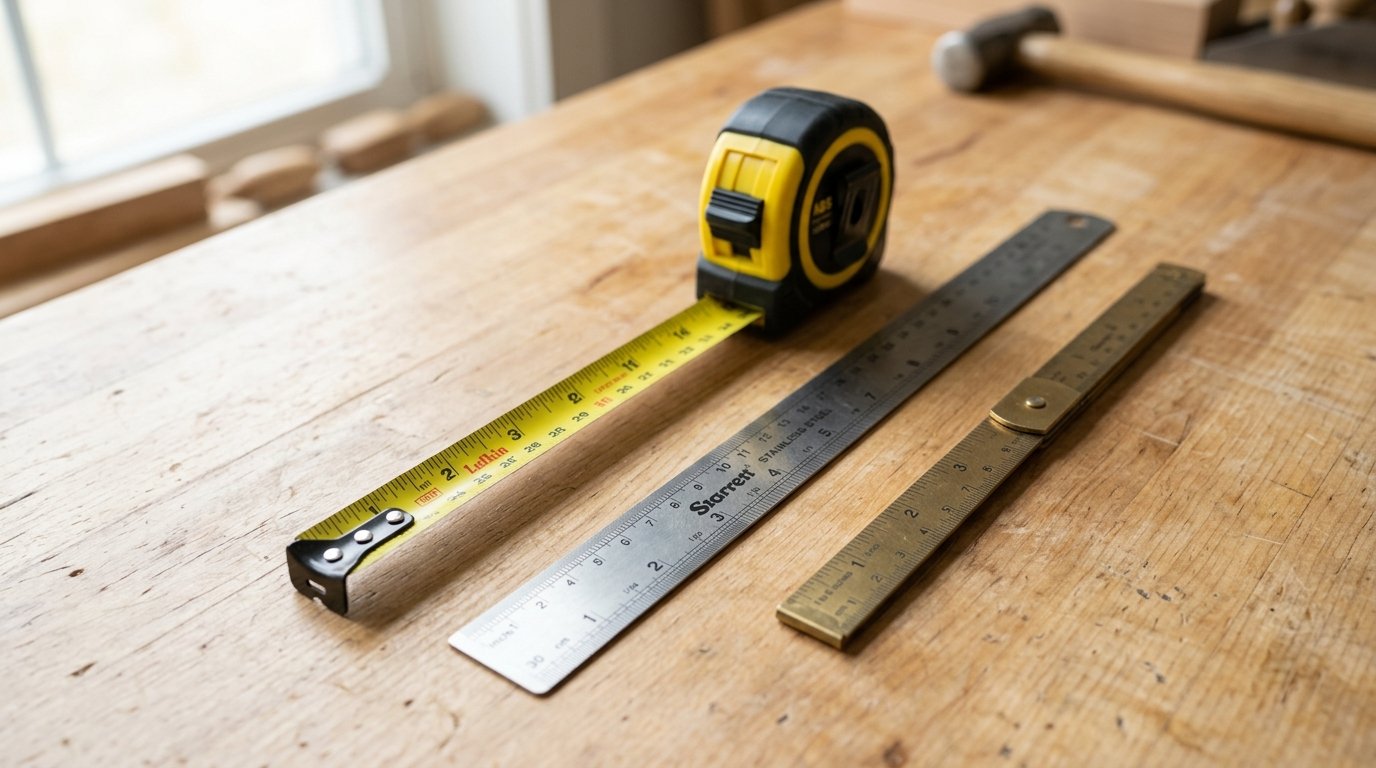
Meter vs. centimeter vs. millimeter, side by side
| Meter | Centimeter | Millimeter | |
|---|---|---|---|
| Symbol | m | cm | mm |
| Relationship to a meter | 1 m | 1 cm = 0.01 m | 1 mm = 0.001 m |
| Relationship to each other | 1 m = 100 cm = 1,000 mm | 1 cm = 10 mm | 1 mm = 0.1 cm |
| Typical use | Room dimensions, height, distance | Small objects, precise measurements | Fine tolerances, thickness, jewelry |
Remember one thing and the rest follows: “centi-” always means one-hundredth. It’s the same prefix that makes a cent one-hundredth of a dollar.
A centimeter is one-hundredth of a meter for the same reason. “Milli-” means one-thousandth, so a millimeter is one-thousandth of a meter — and ten times smaller than a centimeter. That’s why a ruler marked in millimeters shows ten tiny lines between each centimeter mark.
A worked example: measuring a room three ways
Take a room that’s 4 meters long. You can describe it in any of the three units, and watching the numbers shift helps the relationship stick.
Four meters equals 400 centimeters — 4 × 100. It also equals 4,000 millimeters — 4 × 1,000.
None of these are wrong. A contractor might use meters for the overall room, centimeters for furniture placement, and millimeters for a precise cabinet measurement. The unit changes to match the precision needed, not because the room’s size changes.
Two other metric mix-ups worth clearing up
These aren’t about which unit is bigger. They’re about what the unit actually measures — and that trips people up just as often.
Is milliliters (mL) a measure of volume or mass?
Volume. A milliliter measures how much space a liquid or gas takes up, not how much it weighs.
This gets confusing because 1 mL of pure water weighs almost exactly 1 gram. The two numbers look interchangeable, but that link only holds for water.
Take honey: 1 mL weighs noticeably more than 1 gram, because honey is denser — about 1.4g per mL. Vegetable oil runs the other way, at about 0.92g per mL, so 1 mL weighs slightly less than 1 gram.
Milliliters and grams only match by coincidence, for one specific substance. That’s why recipes sometimes list an ingredient in milliliters and other times in grams.
A baker who measures flour by volume instead of weight can end up with inconsistent results. A scale reading grams stays accurate regardless of density.
Is a kilogram (kg) a measure of mass or weight?
Mass, technically. In everyday non-scientific use, “weight” gets used interchangeably, and nobody minds.
The technical distinction: mass is how much matter something contains, and it doesn’t change based on location. Weight is the force gravity exerts on that mass, and it does change.
An object with a mass of 1 kg would weigh about one-sixth as much on the Moon as on Earth. Its mass stays identical in both places — 1 kg is 1 kg — because the Moon’s gravity is roughly a sixth of Earth’s.
Bathroom scales, kitchen scales, and shipping labels all use “kg” to mean everyday weight. That’s a fine practical shorthand; the mass/weight distinction mostly matters in physics, not daily life.
It’s the same logic behind the old riddle about a kilogram of feathers versus a kilogram of steel. Neither is heavier — they share identical mass. The steel is just denser, so it takes up far less space to weigh the same amount.
Why the metric system splits into so many prefixes
Different scales need different levels of precision. Measuring a room in millimeters produces unwieldy numbers — a 4-meter room becomes 4,000mm.
Measuring a screw thread in meters would go the other way, forcing awkward decimals like 0.006m instead of a clean 6mm.
Prefixes — milli-, centi-, kilo- for large distances — let you pick the unit that keeps numbers easy to read. A road distance gets reported in kilometers (1 km = 1,000 m) for the same reason fabric width gets reported in centimeters rather than meters: the unit should match the object.
How this compares to inches, for context
A lot of confusion comes from switching between metric and imperial without noticing. It helps to anchor the scale.
An inch (2.54 cm) is bigger than a centimeter. A centimeter, in turn, is bigger than smaller imperial units like a sixteenth of an inch, which runs about 1.6mm.
So while a centimeter looks small next to a meter, it’s actually a bit smaller than an inch. That detail surprises people who assume “centimeter” and “inch” are roughly interchangeable everyday units.
Where these mix-ups actually cause problems
Mixing up mass and volume, or misreading a metric prefix, isn’t just an academic worry. It has caused real, documented failures.
In 1999, NASA lost the Mars Climate Orbiter over exactly this kind of error. One engineering team’s software produced thrust data in pound-force units, while the navigation team’s software expected newtons — a metric force unit.
The mismatch sent the spacecraft off course. It destroyed a $327 million mission.
That’s an extreme example, but the same category of mistake shows up on a smaller scale constantly. A nurse or parent misreads a liquid medicine dose because a syringe is marked in mL while the instructions say “teaspoons.”
A home renovator orders the wrong amount of material because a supplier quoted centimeters and the buyer assumed millimeters. That mix-up is a tenfold difference — one that shows up fast on an invoice.
The stakes are usually lower than a spacecraft. But the underlying mistake — treating two different kinds of unit as interchangeable — is exactly the same.
A simple way to avoid the mix-up
Before trusting any converted number, ask two questions. What physical quantity is actually being measured — length, volume, or mass? And which specific unit within that category is being used?
Getting the category right prevents the mass/volume confusion covered above. Getting the specific unit right prevents the decimal-point-sized errors that come from mixing up mm and cm.
One small habit catches a surprising number of these errors: write out the full unit name instead of the symbol. “Centimeters” is harder to misread than a hastily scrawled “cm” that could be mistaken for “mm.”
That habit alone prevents a wrong purchase or a miscalculated recipe more often than people expect.
Frequently Asked Questions
How many centimeters are in a meter?
Exactly 100. No rounding — the metric system is built on clean powers of 10.
Is a millimeter bigger or smaller than a centimeter?
Smaller. A centimeter equals 10 millimeters, making mm the smallest of the three common length units in everyday use, followed by cm, then m.
Why does the metric system use meters, centimeters, and millimeters instead of just one unit?
Different scales call for different precision. Measuring a room in millimeters produces unwieldy numbers, while measuring a screw thread in meters forces awkward decimals. Prefixes let you pick the unit that keeps numbers readable.
Is a centimeter bigger than an inch?
No. An inch is bigger — 1 inch equals 2.54 centimeters, so an inch runs more than twice the length of a centimeter.
Is a liter the same as a kilogram?
Only for water, and only approximately. One liter of water weighs almost exactly 1 kilogram — the same coincidence that makes 1 mL of water weigh 1 gram. A liter of milk, oil, or honey weighs something different, because volume and mass are linked only by a substance’s density.
Which is larger, a meter or a yard?
A meter is slightly larger. One meter equals about 1.094 yards — roughly 3.4 inches longer than a yard. Close enough that people sometimes treat them as interchangeable, though they aren’t identical.
Is a gram heavier than a milligram?
Yes, by a lot. One gram equals 1,000 milligrams, which is why medication doses are often listed in milligrams — the smaller unit avoids awkward decimals like 0.005g for a 5mg tablet.